Until recently, the question “Do backlinks work?” was mainly about Google. Now, ChatGPT, Google AI Overviews, and other LLM systems systems have joined the mix. As a result, another question comes up more and more often: “Do you need backlinks for GEO?”
At AI SEO Day by WebPromoExperts, I talked about how link-building strategies for GEO differ from SEO, how to build a link-building plan for LLMs, and what works for GEO in 2026. This article covers the key takeaways from my talk.
In short: Backlinks and external brand mentions matter for both Google and LLMs.
It’s not just about the number of links. The authority of referring sources, the diversity of referring domains, topical relevance, and your brand’s overall presence across your niche all play a role.
SEO vs. GEO: How Backlinks, Mentions, and Citations Work
We used to optimize websites for Google and other search engines. Now, we also optimize for LLMs. These two approaches have a lot in common, but there are some important differences.
SEO (Search Engine Optimization) is the process of optimizing websites for search engines such as Google and Bing.
GEO (Generative Engine Optimization) is the process of optimizing content and external signals for generative search engines.
The relationship between them can be illustrated as follows:
- Different types of links from industry blogs, news websites, and other sources build a website’s backlink profile.
- Search engines or AI systems (LLMs) evaluate this profile.
- Based on backlinks or mentions, they decide how to rank the website.
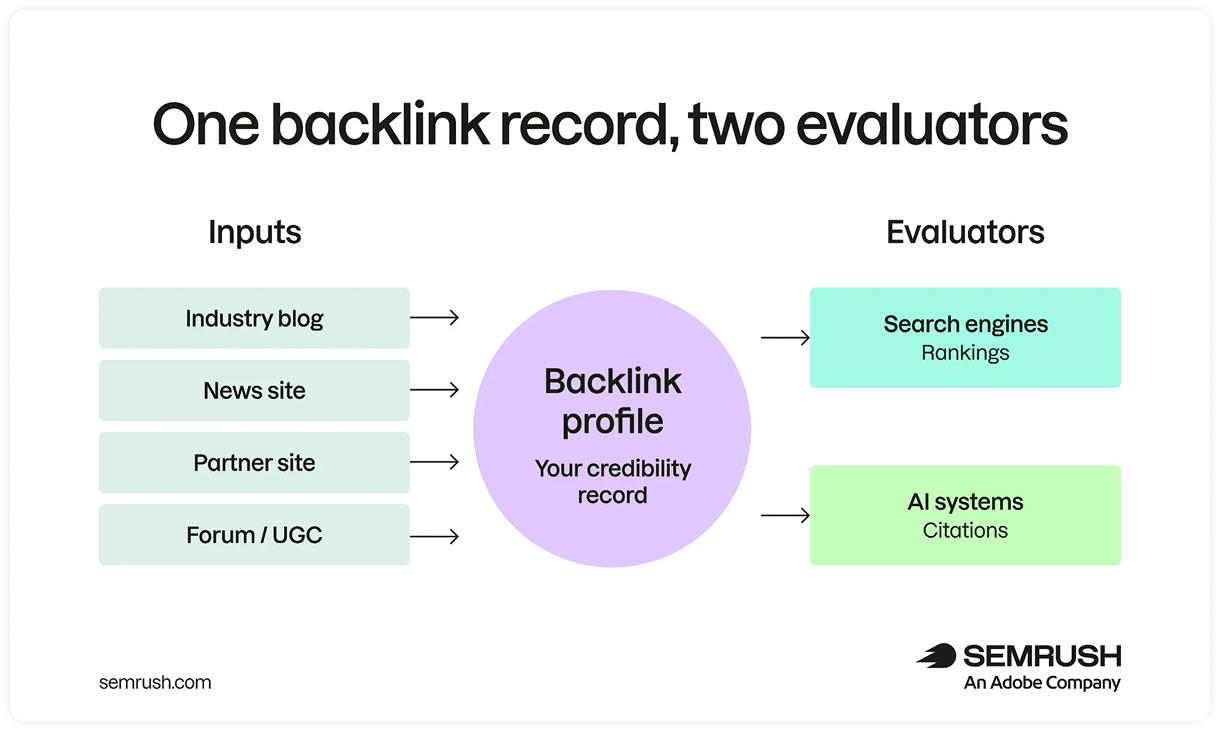
How a backlink profile connects Google rankings with citations and mentions in LLMs (source)
I’d add a fourth step to this model: what happens as a result, namely:
- Higher rankings in Google generally mean a greater chance of being cited in Google AI Overviews;
- Rankings in Bing have a strong influence on mentions in ChatGPT;
- Brand mentions on external websites affect both LLM mentions and Google rankings;
- Being featured in “best” listicles and earning mentions in LLMs can increase citations on YouTube, TikTok, and Reddit, which, in turn, can further strengthen brand rankings.
Citation is a link to a source that appears in an LLM response or an AI Overview.
Mention is when a brand is named in an LLM response, with or without a link.
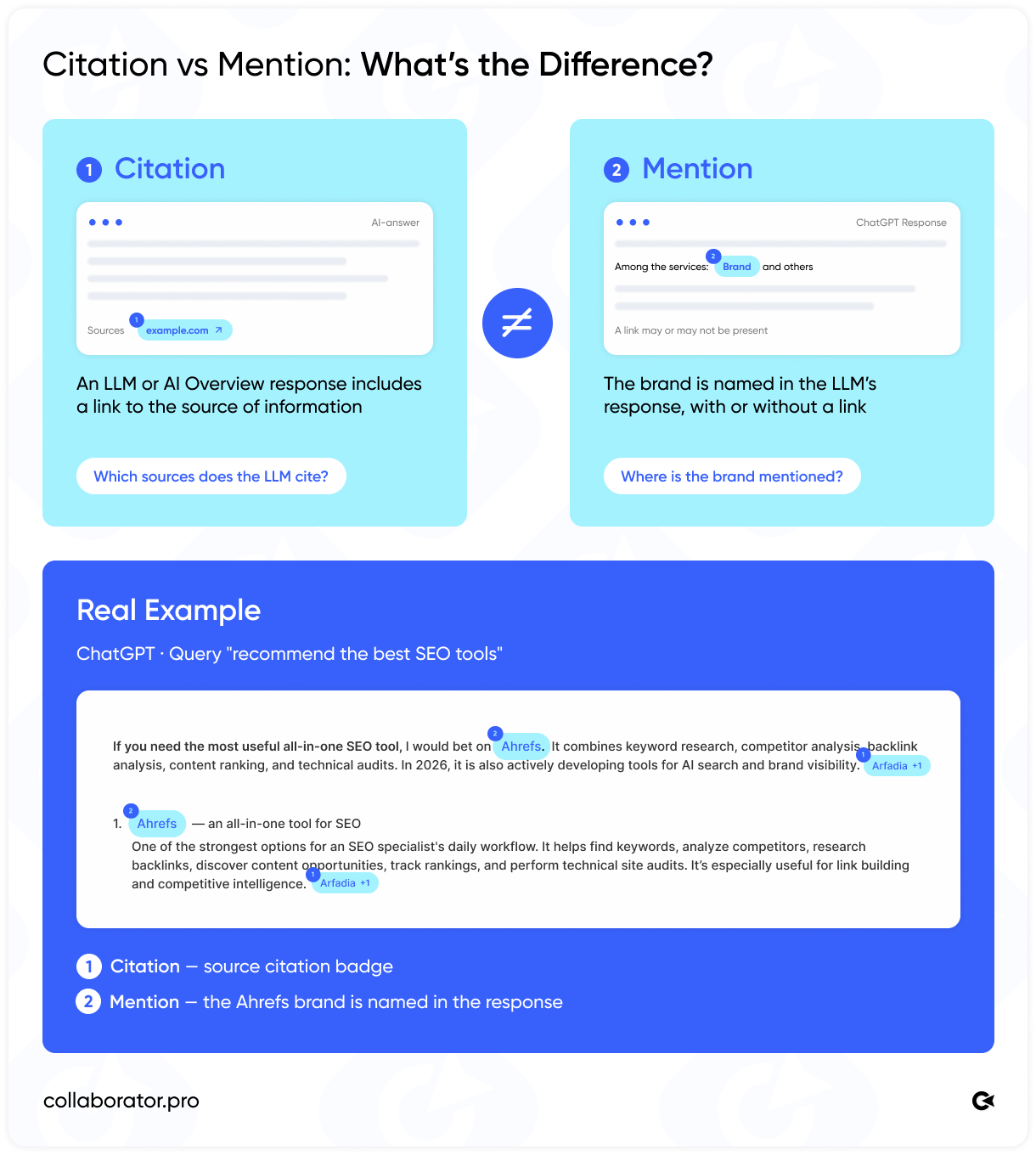
The key change is that search rankings alone are no longer enough to measure visibility. For GEO, you need to understand where your brand is mentioned, which sources LLMs cite, and how different external signals work together.
Google and LLM Ranking Factors
Brian Dean, the former head of Backlinko, updated his well-known study of Google ranking factors in April 2025.
Three of his 12 findings directly relate to links:
- A website’s DR strongly correlates with higher Google rankings.
- Pages with more backlinks rank higher than those without them. Pages in the first position have 3.8 times more backlinks than pages ranking in positions 2–10.
- Getting links from a variety of websites is important for SEO. The study found a correlation between the number of unique referring domains and a page’s rankings.
Referring domain is a unique website that has at least one link pointing to your page. Ten links from the same website count as one referring domain. That’s why a diverse range of sources matters more for rankings than the total number of links alone.
This study is well known and provides a useful starting point for discussing what influences rankings in LLMs.
In another study, Kevin Indig, a well-known SEO consultant, teamed up with Semrush to analyze 1,000 domains and investigate how backlinks affect rankings in LLMs.
Here are the key findings:
1. The higher the Authority Score, the more likely a website is to rank in LLM systems. However, the growth isn’t gradual; it happens in jumps. Trust builds up gradually in the eyes of LLMs, but once a project becomes a leader in its niche, citations increase sharply. That said, the sample of 1,000 domains is relatively small, so further research may refine these findings.
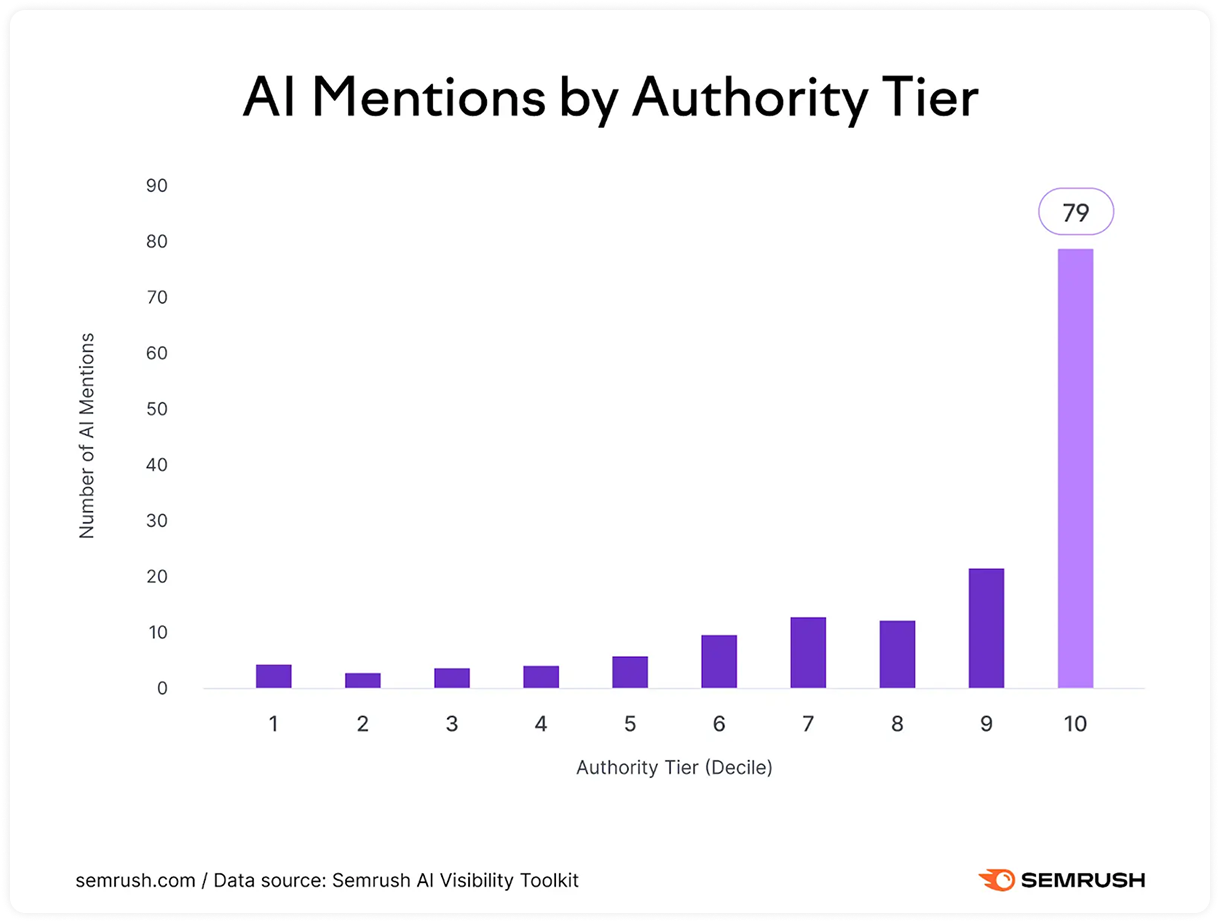
Number of AI mentions by domain authority. Data: Semrush AI Visibility Toolkit (source)
Authority Score is a Semrush metric broadly comparable to Ahrefs’ DR, although the two use different calculation methods. Read more about the study of popular SEO metrics on the Collaborator blog.
2. A few more citations from mid-tier websites probably won’t significantly increase AI citations. You need links from the most trusted sources in your niche.
I don’t entirely agree with this finding. In my experience, getting more mentions from different, unique websites has a positive effect. The real question is how to approach this effectively.
3. Not all external signals carry the same weight. A research paper picked up by authoritative industry blogs is likely to have a greater impact on citations than the number of podcasts featuring top executives over the course of a year. YouTube, however, remains an exception and one of the best sources for LLMs.
There’s a certain contradiction here. On the one hand, an analytical piece is more valuable than an interview. On the other, YouTube is considered one of the best sources. So why not conduct interviews on YouTube and repurpose that content across other channels?
My takeaway is that all types of external signals work, just to varying degrees. What matters is how you put them into practice. You can distribute the same interview across enough platforms to make it visible all over the internet, or produce an industry study that no one in your niche ever notices.
4. Create how-to guides and listicles (“best” articles). Together, these formats account for 62.3% of cited sources. Keep this in mind when planning content for your website or guest posts.
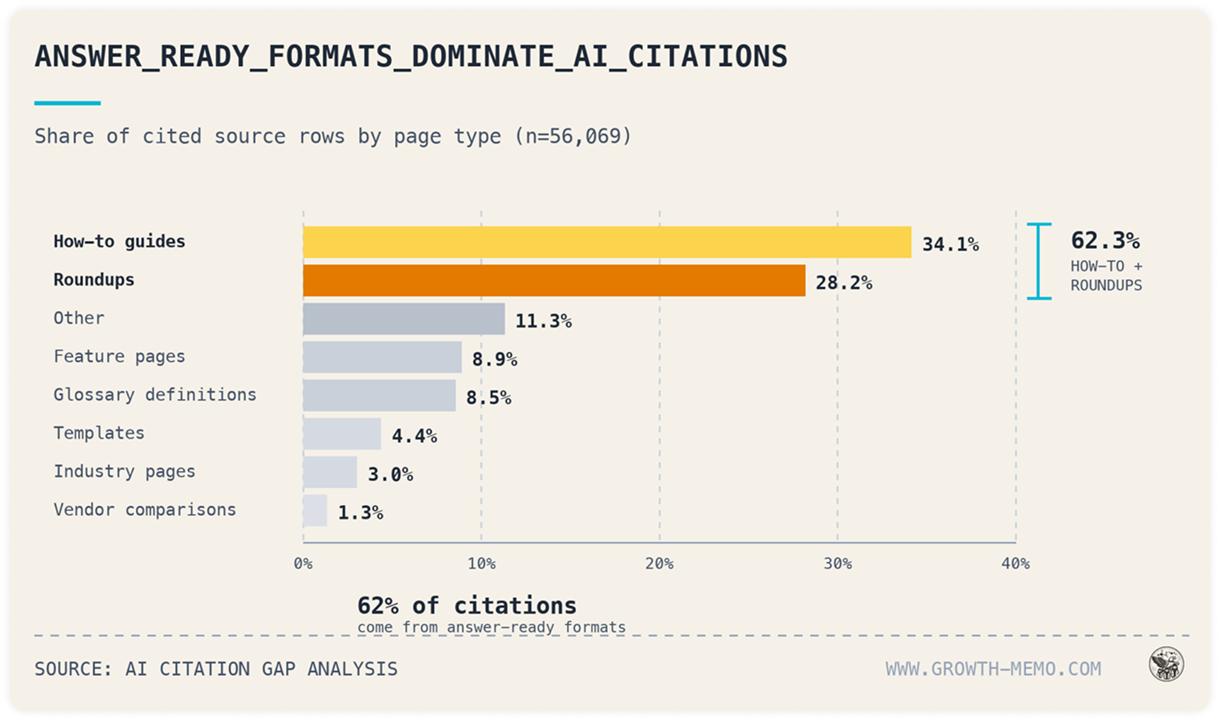
Content formats most frequently cited by AI (source)
If you’re not yet building your website’s authority through external links and citations within your niche, it’s time to start. There’s a direct correlation between this work and the results, so it deserves a place in your budget.
Start by analyzing which authors, YouTube channels, social media accounts, and publications are cited most often in your industry, both by Google and by LLMs. Then focus on getting featured on those platforms.
You can take this a step further by engaging directly with the entities — authors and experts — that LLMs already consider trustworthy in your niche.
This brings me back to my disagreement with the second finding. If you collaborate with a trusted author in your niche, create content together, and distribute it across as many platforms as possible, it’s likely to pay off. Your brand will be cited alongside people and entities that LLMs already recognize as authoritative.
Key takeaways from the two studies:
- A website’s authority — both its link authority and topical authority — is critical for Google rankings and for mentions and citations in LLM systems.
- The number of backlinks from unique sources matters for both ranking systems, although the second study presents a somewhat different picture of their impact.
How to Build a Link-Building Strategy for GEO
To build a link-building strategy for GEO, start with these steps:
- Analyze your current situation. Check whether LLMs mention your brand, whether they cite your website, and how your site ranks in Google.
- Compare your performance with competitors. Set up ongoing monitoring to understand where you stand. Look at competitors that rank well and identify how they differ from your website and the market as a whole.
- Create an annual off-page promotion plan. Set a budget and choose your methods for building links and earning mentions. These may include guest posts — which you can place through Collaborator, outreach, and link exchanges; link insertions through outreach and product-based solutions; community links from Reddit, Quora, niche blogs, and forums, as well as crowd marketing; and directory submissions and other methods for local businesses.
- Define checkpoints and assign responsibility for execution.
This is a straightforward workflow you can present to management or clients, or put into practice yourself.
How Website Authority Develops for SEO and LLMs
There are two ways to build website authority:
- Link authority (domain authority) indicates how trustworthy a website is overall and how many authoritative websites link to it, whether or not they’re topically relevant. To strengthen link authority, focus on placements in media outlets and other general-interest publications.
- Topical authority helps establish your website as a niche leader that gets cited regularly. To build it, earn as many links and mentions as possible from websites in your niche. Topical mentions in relevant articles on general-interest websites tend to have less impact, but they still matter — especially if dedicated niche websites are hard to find.
Not sure where to start? Try Collaborator’s automated competitor analysis tool. You can compare your website with competitors for free, see which websites link to them, and use those insights to shape your own link-building strategy.
Do Backlinks Affect LLM Visibility? A Practical Example
For this example, I chose the commercial search query “car service Kyiv” and selected five random websites from the search results. I pulled the backlink data using Ahrefs Batch Analysis and checked AI visibility in the AI Responses section on each domain’s Overview page.
I uploaded the data to an AI model and asked it to consolidate everything into a single table. Here’s what I got:
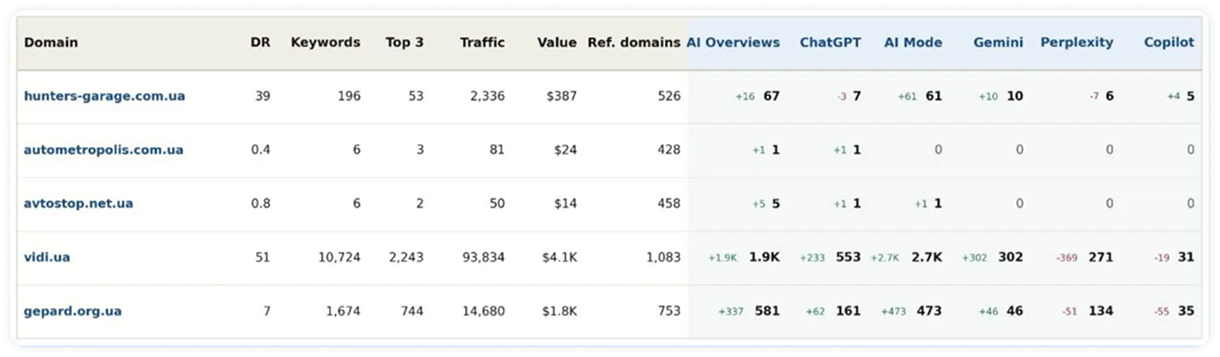
Combined comparison table of five websites ranking for “car service Kyiv”: Google metrics and AI visibility
The correlations observed across larger datasets in the studies mentioned above are also visible in this small sample of five domains:
- Websites that rank well in Google also tend to get more mentions in LLMs, while those that perform poorly in Google tend to receive fewer citations from AI systems.
- There’s no direct linear relationship between the number of backlinks and rankings. A website with 500 backlinks doesn’t perform 50 times better than one with 10. Still, websites with more backlinks generally tend to rank higher.
- The analysis covered backlink quantity, not quality. Including link quality would likely produce even clearer findings.
Build a similar table for your own website and compare DR, keyword rankings, traffic, referring domain counts, and citations in AI Overviews. You can automate this process. It’s also useful when choosing websites for guest posts: check how well potential referring sites rank and whether LLMs cite them.
Collaborator has a metric that tracks website citations in Google AI Overviews. Use it as an additional signal, not the sole criterion when choosing websites for link placements.
The Role of Backlinks in SEO and GEO
Backlinks remain an important external signal for both SEO and GEO. But when it comes to LLMs, simply building more links isn’t enough. You need to strengthen your website’s authority, earn mentions from a variety of quality sources, and establish a presence on the platforms where leaders in your niche are already being cited.
Link building for GEO isn’t a replacement for SEO. It’s a long-term effort to build authority and brand recognition across the wider information ecosystem.
Related reading