You do not need an expensive SEO subscription to see who links to your website. While premium platforms offer deeper analytics, anyone can learn how to check backlinks and get a clear picture of their link profile for free.
In this guide, we’ll explain exactly how to analyze a website’s backlinks (both yours and your competitors') using zero-cost tools. You'll also learn:
- How to separate valuable backlinks from irrelevant, suspicious, or low-value placements.
- How to turn your findings into practical next steps, from protecting valuable links to reviewing suspicious ones and finding competitor backlinks worth pursuing.
TL;DR
- Google Search Console is the best free source for your own site's backlinks, but it shows no competitor data.
- Free backlink checkers (Collaborator, Moz, Ubersuggest) offer the fastest way to analyze any domain you don't own, including competitors.
- Link quality depends on topical relevance, anchor text, and placement context — not on DR/DA scores alone.
- A regular audit every four to six months turns findings into three action lists: links to monitor, links to review for risk, and competitor links to pursue.
Why Should You Check Backlinks in the First Place?
Search engines like Google rely on links to find new pages, crawl your site architecture, and pass authority and trust signals across the web. If you are not keeping tabs on these signals, you won't notice a lost or toxic link until its effect shows up in your traffic.
At the same time, regularly auditing your link profile helps you manage several critical areas:
- Monitor backlink profile health. Knowing who points to your domain ensures your overall link structure remains clean and natural.
- Spot toxic patterns early. Catching sudden spikes in spammy or irrelevant links early allows you to address potential risks before they impact your organic visibility.
- Uncover competitor gaps. Reviewing where other sites in your niche earn their coverage gives you a direct blueprint for pages and publishers you should target next.
- Validate campaign success. When you invest time into digital PR or outreach, tracking new links is the only concrete way to prove your efforts actually paid off.
How to Check Backlinks in Google Search Console?
If you already have Google Search Console (GSC) set up for your domain, it’s the best place to start when checking your own backlinks for free.
Since the data comes directly from Google, GSC gives you a useful first-party view of the links Google has found. Just keep in mind that the report only shows a sample, not every backlink pointing to your site.
Here’s how to find and export the data:
- Open Google Search Console. Log into your dashboard and select the verified property for your website from the dropdown menu in the top-left corner.
- Navigate to the Links Report. Scroll down the left-hand navigation menu. Near the bottom of the list, click on Links to open the main reporting interface.
- Analyze External Links. From here, you can open different reports to explore your backlink data in more detail.
You’ll see three main sections worth checking:
- Top linked pages: The specific URLs on your site that have earned the most backlinks.
- Top linking sites: The unique root domains pointing to you (your referring domains).
- Top linking text: The anchor text most frequently used by other sites when they link to you.
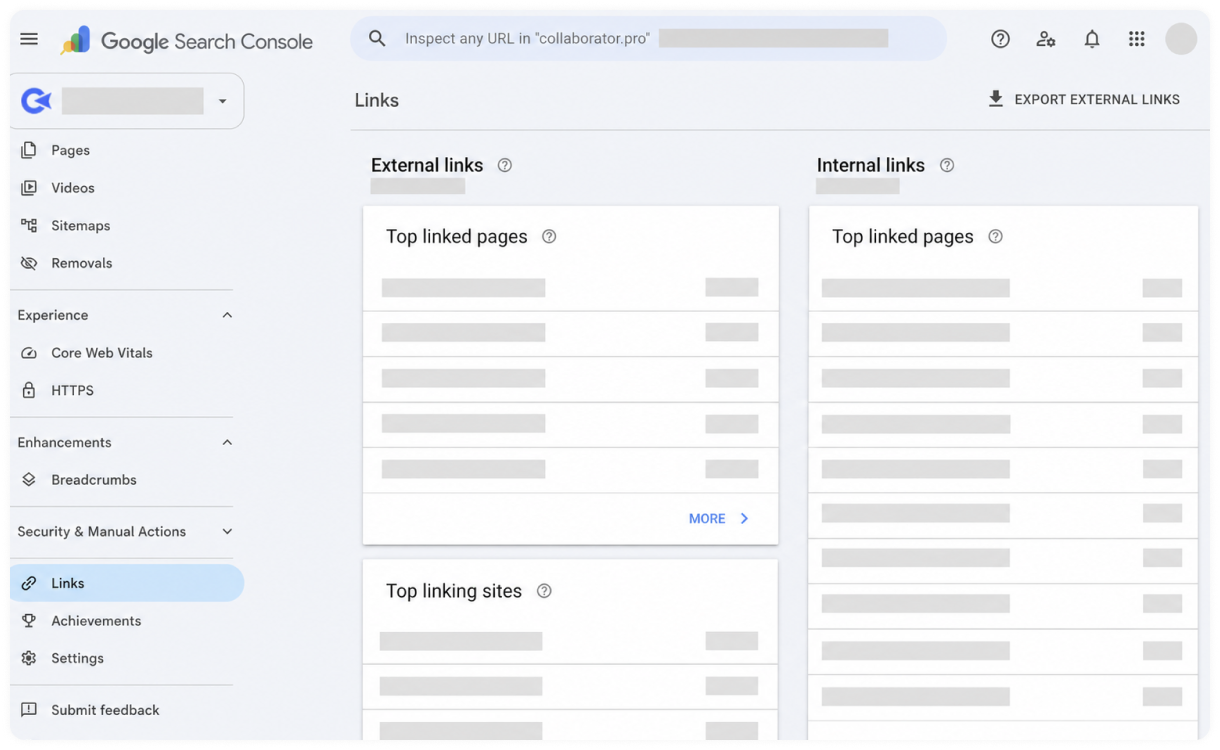
Click on any of these individual sub-reports to see an expanded view. In the upper-right corner of the screen, you can also hit the Export button to download the data as a Google Sheet or CSV for easier sorting and filtering.
The Limitations of GSC Data
While GSC is a useful free resource, it shouldn't be the only tool in your kit. Its main limitations include:
- No competitor insights
- The platform shows a sampled selection of links
- The export files do not specify link attributes
That's why the best free approach is not choosing one method. It is using each method for the job it does best: Search Console for your own verified site, and a free backlink checker when you need backlink metrics or competitor data.
What's the Fastest Way to Check Backlinks for Free?
The fastest way to check backlinks for free is to drop a URL or root domain directly into a third-party free backlink checker. Using a dedicated backlink tool gives you important layers of data that GSC leaves out:
- Competitor analysis. You can analyze any domain on the web instantly without needing ownership verification.
- Historical context. See a timeline of newly acquired vs. lost links to see if your profile is growing or shrinking.
- Link attributes. Instantly sort your links by dofollow (links that pass authority) and nofollow (links that don't pass authority but still drive traffic).
- Anchor text distribution. See a bird's-eye view of the exact phrases people use to link to a site, helping you watch out for keyword over-optimization.
For example, in Collaborator's Free Backlink Checker, you can enter a domain or URL and review up to 100 results, split between the site’s 50 strongest and 50 newest backlinks. You get 5 checks per day without signing up, or 20 per day with a free account.
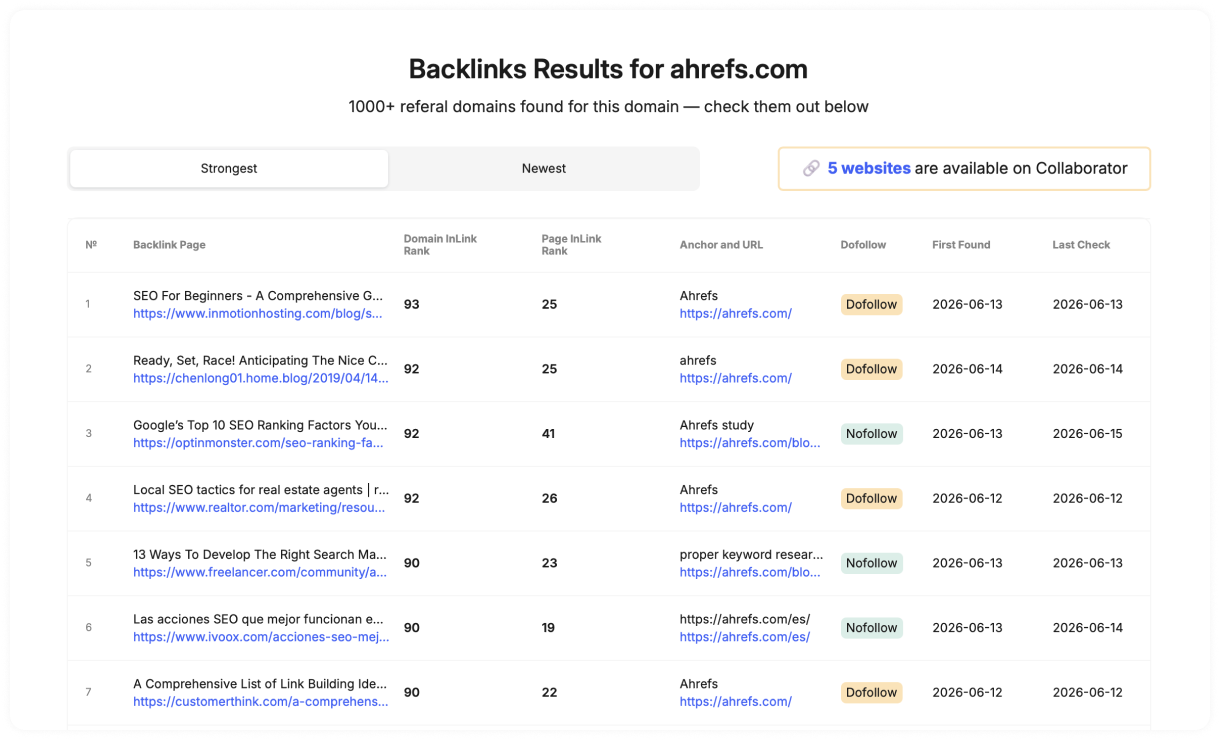
This gives you a fast snapshot of who links to the site, what pages they link to, and what anchor text they use. If a referring domain is also listed in the Collaborator marketplace, the tool flags it, so you can see which backlinks you could secure directly.
If you want a second free view, Moz Link Explorer adds a different type of context. With a free account, you can check top pages on the site, top anchor texts, and linking domains by DA.
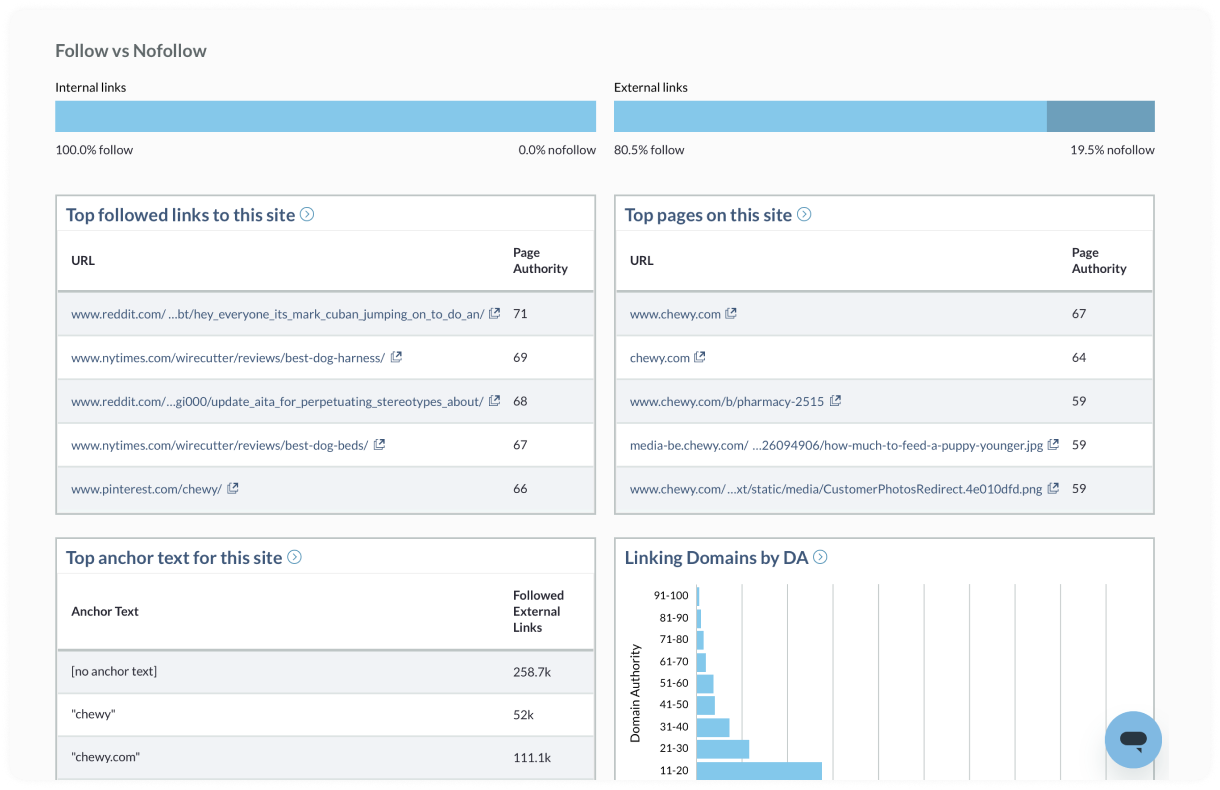
That makes it helpful when you want to understand not only who links to a site, but also how strong those linking pages or domains may be.
Finally, if you need a tool that flags potentially risky backlinks, you can check the Ubersuggest Free Backlink Tool. Its backlink report includes Spam Score, DA/PA, anchor text, and first seen/last seen dates.
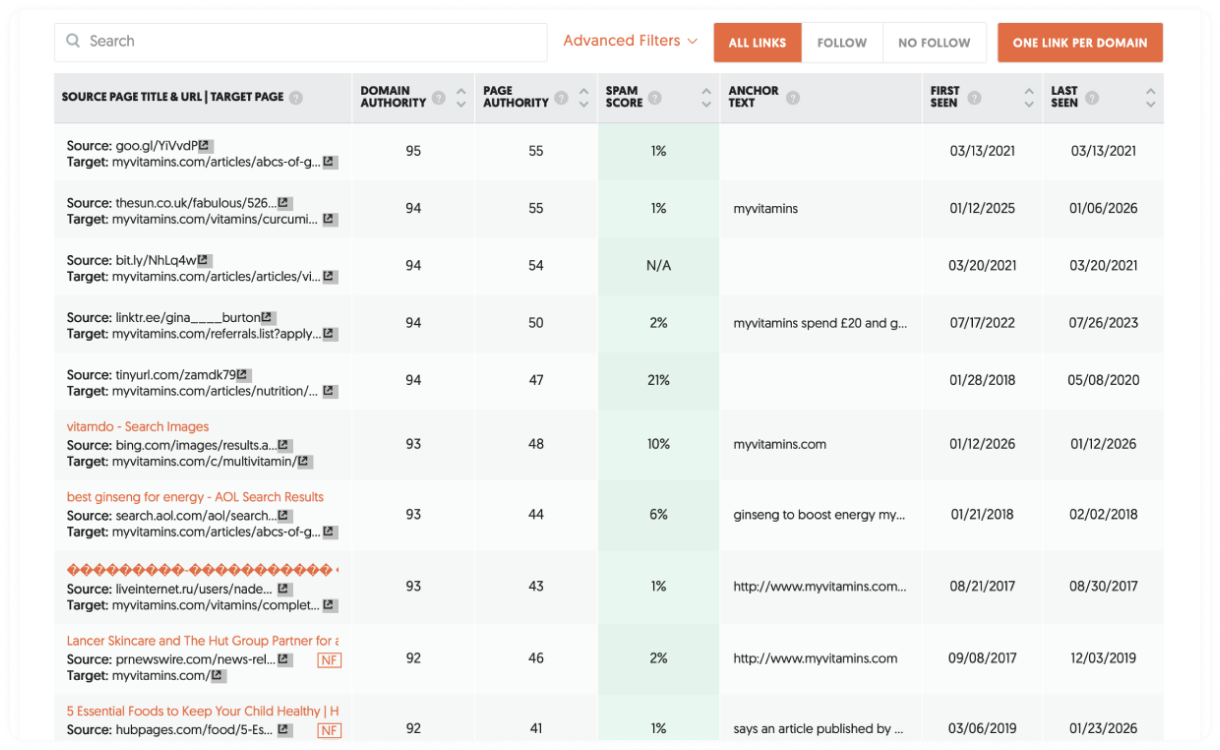
Still, it's best to treat Spam Score as a review signal, not a final verdict: it tells you which links to inspect manually before making decisions.
As a quick review, here's how these free tools compare and where each one is helpful:
|
Tool |
Best for |
Free data you can use |
|---|---|---|
| Google Search Console | Own verified site backlinks | Top linking sites, top linked pages, top linking text |
| Collaborator Free Backlink Checker | Fast backlink snapshot for your site or a competitor | Strongest/newest backlinks, anchor text, follow/nofollow, marketplace availability |
| Moz Link Explorer | Authority and lost-link context | Domain Authority, Page Authority, top anchor text, limited lost-link data |
| Ubersuggest | Potential spam signals | Spam Score, DA/PA, anchor text, first seen/last seen dates |
That said, the tools listed here are not your only free options. If you'd like a more extensive list, we tested nine no-cost backlink analysis tools (including how many checks you get per day) in our 9 Best Free Backlink Checkers and Monitoring Tools.
Can You Check a Competitor's Backlinks?
Yes, and you absolutely should. Checking a competitor's backlink profile can show you the exact websites linking to them, as well as:
- which content formats attract the most links;
- what anchor text people use and how they describe the brand;
- which publishers, blogs, directories, or media sites already cover companies like yours.
You can then group their backlinks into buckets that are easier to act on:
- Guest posts from industry blogs where the competitor contributed an article.
- Listicles and roundups where similar tools, products, or services are already being compared.
- Resource pages that collect useful companies, tools, guides, or industry links.
- PR and news mentions from media outlets, newsletters, podcasts, or niche publications.
The point is not to copy every link. It is to find the competitor backlinks that are relevant, realistic, and worth trying to replicate.
How Do You Know if a Backlink is Actually Good?
To separate high-quality links from potential cleanup risks, you need to look at a combination of contextual and technical signals:
- Topical relevance. This is the most important signal. The linking website and the specific page hosting your link should naturally overlap with your niche.
- Anchor text. Google's link best practices explicitly state that anchor text should be descriptive, concise, and relevant to the page you are linking to. Brand-name anchors or conversational phrases are completely normal, but over-optimizing your profile with keyword-stuffed anchors can raise red flags.
- Authority metrics (used with caution). Third-party metrics like Domain Rating (DR) or Domain Authority (DA) are helpful for a quick check, but they should never be your sole baseline. These numbers can be artificially inflated — our own study comparing Ahrefs data with GA and GSC shows why it pays to cross-check several signals — so always look past the score to see if the site publishes quality content.
- Placement context. An ideal backlink sits naturally within the main body text of an informative article (an editorial link). Links buried in site footers, sidebars, or generic comment sections carry significantly less weight and often look unnatural to search crawlers.
- Link attributes (follow vs. nofollow). Standard dofollow links directly pass ranking credit, but nofollow links are not worthless. They still diversify your overall link profile, put your brand in front of new eyes, and drive referral traffic from target audiences.
What To Do After You've Checked Your Backlinks
Depending on what your audit reveals, you can translate your findings into a few actionable tasks:
|
If you find... |
Your next action should be... |
|---|---|
| Relevant backlinks from strong pages | Keep them on your monitor list. These are the links worth protecting if a page moves, redirects, or gets updated later. |
| High Spam Score or suspicious link patterns | Review the actual linking pages before taking action. A score is only a flag; look for irrelevant sites and repeated exact-match anchors. |
| Competitor backlinks you could realistically replicate | Add them to your outreach list. Prioritize listicles, roundups, resource pages, guest posts, and niche publishers that already link to similar companies. |
| Anchor text patterns that look too narrow or over-optimized | Balance future link-building campaigns with more natural anchors: brand names, URLs, product names, and descriptive phrases. |
As a rule of thumb, run a backlink audit every four to six months. If your site earns links often or already has a large backlink profile, a paid monitoring tool may be worth it so you can track changes as they happen.
Related reading
- • How to Spy on Your Competitors to Capture Similar Links
- • 9 Best Free Backlink Checkers and Monitoring Tools in 2026
- • What is a Backlink Profile? Build a Strong One in 2026
- • Free Backlinks: 55 High-Authority Sites List to Build Links for Free in 2026
- • Collaborator Introduces a Free Backlink Checker: What It Shows & How to Use
- • Link Insertions: How They Work and How to Evaluate Them