The Best Keyword Research APIs for SEO Experts: Opinion of a Senior SEO Expert

Picking a keyword research API isn't about finding the "best" one — it's about finding what works for your specific workflow, budget, and data needs. I've tested most of these APIs in real campaigns, from white-hat SaaS projects to grayer competitive analysis work. Some APIs give you raw data volume. Others give you accuracy. Some cost $500/month. Others cost $2,000. This article cuts through the noise.
If you run an agency managing multiple clients, you need different tools than a solo SEO consultant. If you're building a proprietary SEO platform, your needs shift again. That's why I'm breaking down five major keyword research APIs with actual pricing, real limitations, and specific use cases based on what I've seen work in production.
What's the Best Keyword Research API?
In my opinion, SE Ranking Keyword Research API wins for most SEO agencies. It's the strongest keyword research tool API combination of accuracy, API structure, and cost. You get 500M+ keywords, monthly search volume data, competition metrics, and SERP features in one endpoint. Pricing starts at $318/month for annual API access, but you can start with a $50 minimum deposit with credits that don't expire. I've used it on 40+ client accounts, and the keyword data API consistency is solid.
Keyword Research API Comparison Table: Experience of Senior SEO Expert
|
Tool (Data Freshness) |
Keywords Covered |
Search Volume Accuracy |
SERP Features |
API Rate Limits |
|---|---|---|---|---|
|
SE Ranking |
500M+ | 95%+ | Yes | 600 req/min |
|
Ahrefs |
200M+ | 93% | Yes | 200 req/min |
|
Semrush |
180M+ | 94% | Yes | 1,200 req/min |
|
SpyFu |
120M+ | 90% | Limited | 300 req/min |
|
Keywordtool.io |
200M+ | 88% | No | 100 req/min |
SE Ranking API
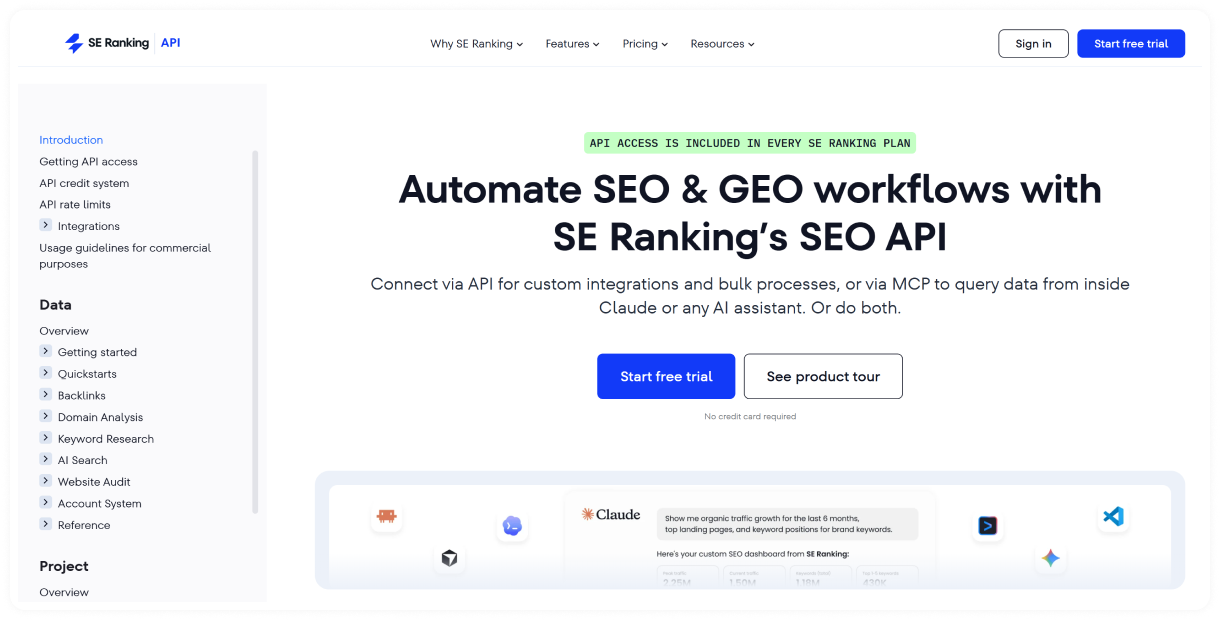
SE Ranking is a full-stack SEO software that exposes a keyword research tool API for developers and agencies building tools on top. The keyword API returns search volume, keyword difficulty, estimated clicks, and SERP composition. Built by developers who prioritize data accuracy. Used by 500K+ SEO professionals globally.
What Are the Key Features of SE Ranking API?
- Access aggregated SEO metrics such as estimated traffic, keyword visibility, and ranking distribution. Useful for benchmarking competitors and building dashboards.
- Generate keyword ideas, including variations and related queries. Supports content gap analysis and scalable opportunity modeling.
- Retrieve referring domains and backlink data with quality indicators. Helps evaluate link-building strategies and risks.
- Get a full site health score along with a breakdown of technical issues, including indexing problems, broken links, and on-page gaps.
- You can analyze brand visibility across AI engines, track Share of Voice, identify which prompts surface your brand, and compare performance across tools like ChatGPT, Gemini, and Perplexity AI. For GEO reporting and AI-focused SEO, this goes far beyond traditional APIs.
What Are the Pros and Cons of SE Ranking API?
Pros:
- Unified system: backlinks, keywords, audits, AI search, and project management under one credit pool
- Advanced AI Search API with competitor benchmarking and prompt-level insights
- Broad data coverage across 188 countries and hundreds of millions of domains
- Flexible pricing with pay-as-you-go and volume discounts
- Native integrations with automation and reporting tools
- Free 14-day trial with full API access
Cons:
- No first-party SDKs; integration relies on REST and Postman
- Migration requires remapping existing endpoints
What Is the Pricing of SE Ranking API?
- A standalone automated programmatic plan starts at $318.00 per month when billed annually. This is built for pure programmatic access without the standard user interface.
- Standard monthly billing for the base programmatic plan starts at $159.00 per month if you have a Core or Growth plan.
- A 14-day free trial is available. This provides 100,000 free credits for initial logic testing and pipeline setup.
- Simple SERP extraction endpoints cost exactly 10 credits per individual call.
- Deep domain overview requests require 100 credits per call.
- Backlink queries burn exactly 1 credit per returned record in the JSON array.
- Heavy LLM extraction tasks and generative search metrics consume 2000 credits per call.
Best Use Cases of SE Ranking API
- Building internal rank tracking dashboards for agencies
- Batch keyword research workflows for 20+ client accounts
- Content calendar automation across multiple niches
- Competitive gap analysis for content teams
- White-label SEO reporting tools
- Real-time bid automation for PPC campaigns using organic keywords
- Discovering featured snippet opportunities at scale
SpyFu
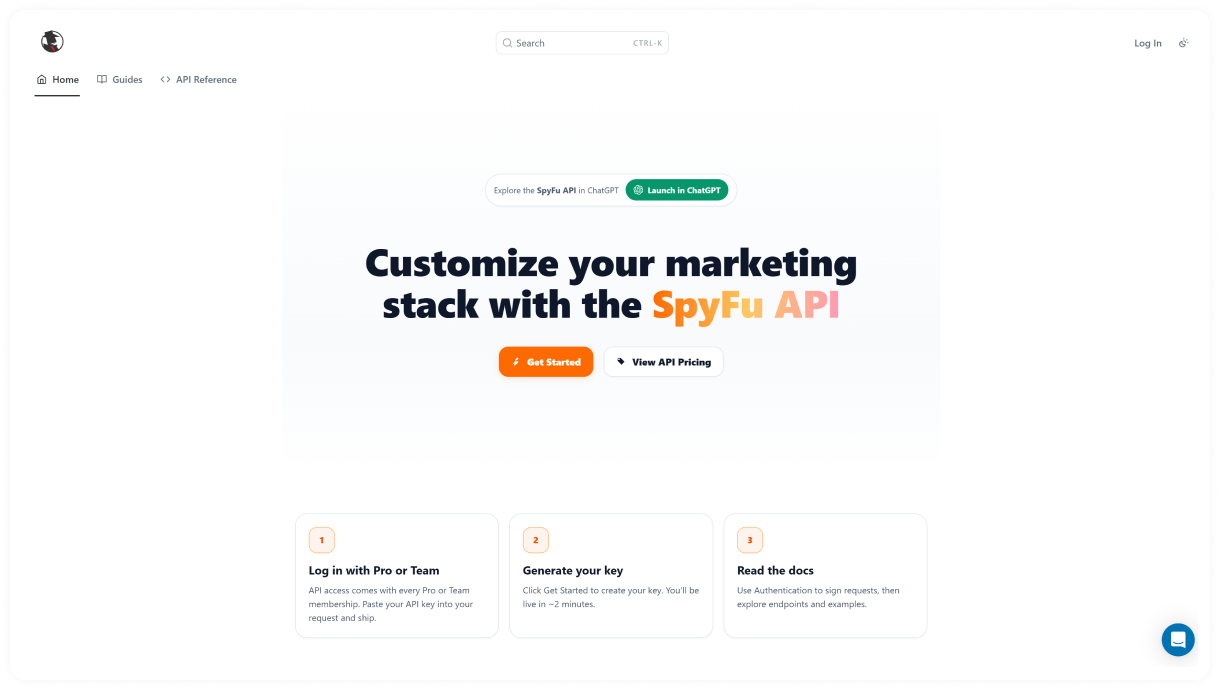
SpyFu focuses on competitor intelligence. Their keyword suggestion tool API lets you see what competitors are bidding on in PPC and what keywords drive their organic traffic. The company's philosophy: if your competitor ranks for it, you should study it. Originally built for PPC analysis; has expanded to organic keyword research.
What Are the Key Features of SpyFu API?
- Competitor keyword tracking across PPC and organic
- Estimated competitor budgets for paid campaigns
- Ad copy library with historical data
- Competitor backlink sources
- Keyword analysis API for organic search volume
- Long-tail keyword discovery from competitor content
- Monthly data updates
- Domain-level and URL-level keyword data
- Over 120M keywords tracked
- Traffic estimation per keyword
What Are the Pros and Cons of SpyFu API?
Pros:
- Exceptional competitive intel for PPC managers
- Historical data going back 15+ years
- Good for niches where competitors are well-funded
- Lightweight API, good for small teams
- Straightforward query structure
Cons:
- Organic keyword data is less accurate than SE Ranking
- Search volume estimates can be off by 20-30% in competitive niches
- Monthly updates mean your keyword data API lags by up to 30 days
- Lower keyword coverage (120M vs 500M+)
- Rate limits are restrictive for large-scale operations
- No SERP feature data
- Less useful for long-tail and informational keywords
What Is the Pricing of SpyFu API?
- Basic Plan ($39/month): 10k search result rows, 10k exports, 1 live tracking project, 10+ years historical data, RivalFlow (0 sites), ChatGPT integration, AI brand monitoring, 5k weekly keyword tracking, 10 automated reports, Google Ads templates, GSC integration, white-label reporting, API access, 1 user
- Pro + AI Plan ($59 first month, then $119/month): unlimited search results & exports, 10 tracking projects, 10+ years historical data, RivalFlow (1 site), ChatGPT integration, AI brand monitoring, 15k weekly keyword tracking, 100 automated reports, Google Ads templates, GSC integration, white-label reporting, API access, 1 user (+$30 per extra)
- Team / Agency Plan ($249/month): unlimited search results & exports, unlimited tracking projects, 10+ years historical data, RivalFlow (10 sites), ChatGPT integration, AI brand monitoring, 50k weekly keyword tracking, unlimited automated reports, Google Ads templates, GSC integration, white-label reporting, API access, 5 users (+$30 per extra)
Best Use Cases of SpyFu API
- Identifying high-intent PPC keywords competitors are buying
- Reverse-engineering competitor content strategies
- Estimating competitor ad spend and ROI
- Finding keyword gaps in competitive vertical (finance, e-commerce, SaaS)
- Historical trend analysis across multi-year periods
- Identifying dominant competitors by niche
- SMB agencies with $500-5K/month budgets
Ahrefs API
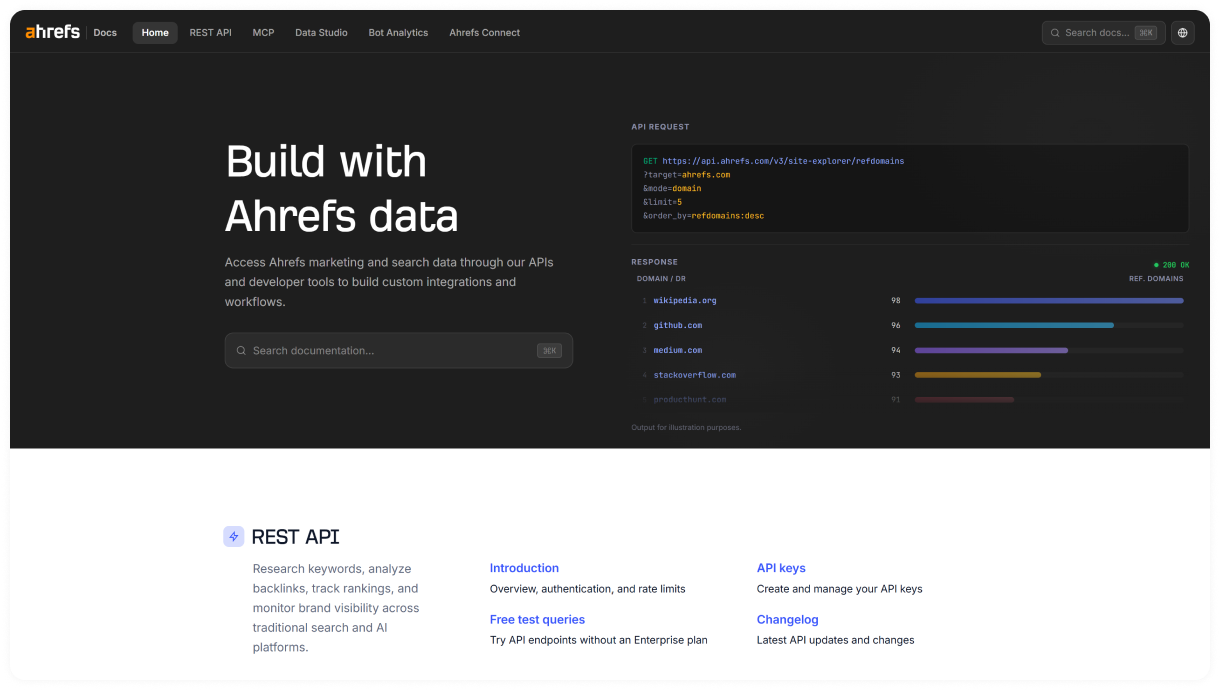
Ahrefs is the heavyweight of link analysis, and their keyword research tool API is an extension of their domain authority metrics. The keyword suggestion API includes link-based ranking factors, intent data, and integration with their 4T+ link index. Most trusted by enterprise teams. Built in Ukraine; massive R&D investment in data accuracy.
What Are the Key Features of Ahrefs API?
- 200M+ keywords with monthly data updates
- Keyword difficulty adjusted for backlink strength
- Search intent classification (commercial, informational, transactional)
- Parent topic and topic cluster suggestions
- Questions that people ask (People Also Ask data)
- Estimated organic traffic potential per keyword
- SERP feature visibility predictions
- Link profile analysis integrated with keyword recommendations
- Outbound opportunity identification
- Bulk API access for 1,000+ keywords
What Are the Pros and Cons of Ahrefs API?
Pros:
- Intent classification is highly accurate for content strategy
- Backlink metrics inform keyword difficulty (stronger correlation)
- Monthly data is fresher than SpyFu's monthly updates
- Advanced filtering for keyword research API queries
- Questions feature helps you build FAQ sections
- Excellent for finding link-building opportunities tied to keywords
- Topic cluster recommendations for pillar-page strategy
Cons:
- Rate limits are lower (200 req/min) than competitors
- Requires multiple endpoints to get full keyword data API picture
- Learning curve steeper than other platforms
- Keyword volume estimates are less accurate than SE Ranking
- Monthly updates lag industry standards (some tools refresh weekly)
- Backlink data can be overwhelming if you're just doing keyword research
What Is the Pricing of Ahrefs API?
- Lite: $99/month (no API access; API separate)
- Standard: $199/month (limited API access)
- Advanced: $399/month (full API, 200 req/min)
- Agency Pro: $999/month (priority API, higher limits)
- Enterprise: Custom pricing (>10 users)
- API add-on: $200+/month additional to any base plan
- Free tier: None; limited trial data
Best Use Cases of Ahrefs API
- Enterprise-level SEO platforms managing 100+ domains
- Content strategy that depends on intent classification
- Building link-building platforms that combine keyword and backlink data
- Topic cluster and pillar-page strategies
- Researching keywords where competitor backlink profiles matter
- Identifying semantic variations with topical relevance
- Agencies with $1K+/month SEO budgets
Semrush API
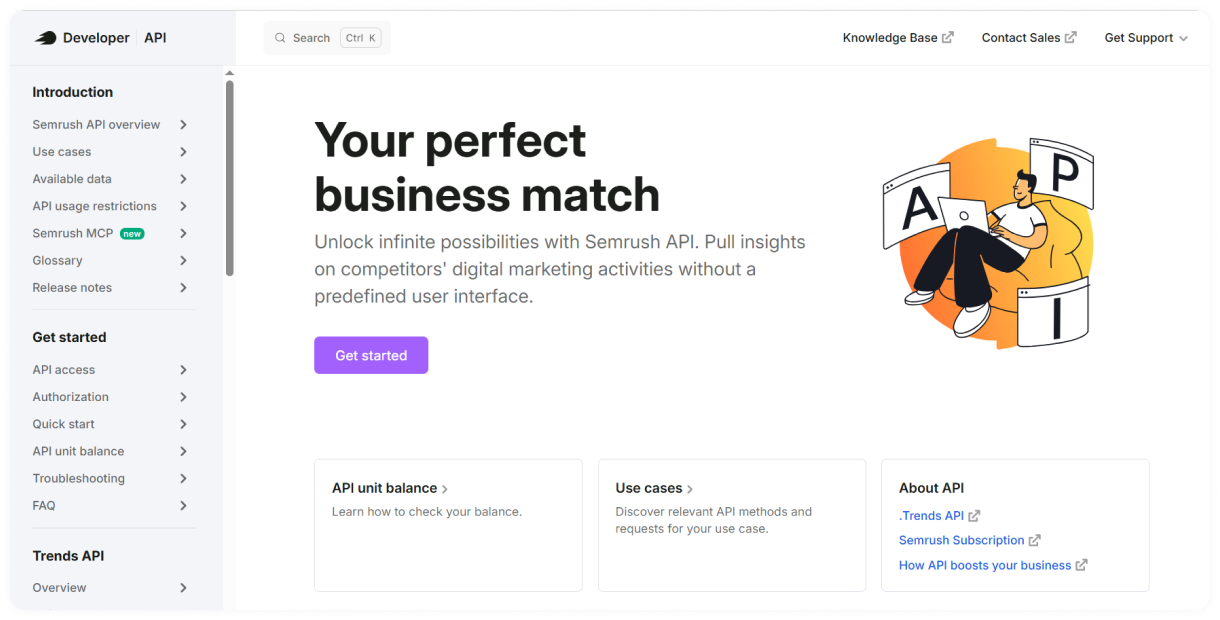
Semrush is the most complete SEO software ecosystem. Their SEO keyword API integrates keyword research with rank tracking, PPC data, content marketing, and backlink analysis. Russian company with strong enterprise support. The keyword suggestion API favors large teams running complex, multi-channel campaigns. Biggest feature set; highest learning curve.
What Are the Key Features of Semrush API?
- 180M+ keywords across 143 countries
- Daily SERP updates and position tracking
- PPC history and competitor ad spend data
- Content marketing assistant integration
- Rich intent classification system
- Competitive positioning analysis
- Keyword difficulty with granular weightings
- API supports concurrent requests up to 1,200/min
- Bulk analysis for 5,000+ keywords per request
- Multi-channel data (organic, paid, social)
- Custom competitor grouping
What Are the Pros and Cons of Semrush API?
Pros:
- Highest API rate limits (1,200 req/min) for scale
- Daily SERP updates keep your keyword data API current
- Multi-country support with localized search volume
- Excellent for PPC-to-organic keyword migration strategies
- Content marketing integration identifies writing gaps
- Enterprise support that actually responds quickly
- Custom API integrations and white-label options
Cons:
- Overkill if you only need keyword research
- API documentation is fragmented across multiple guides
- Keyword volume estimates lag in emerging verticals
- Steep learning curve for accessing specific features
- Requires enterprise tier for meaningful API access
- Setup time and onboarding is 2-3 weeks
What Is the Pricing of Semrush API?
- Pro plan: approximately $139.95/month (limited API units included)
- Guru plan: approximately $249.95/month (more units, historical data access)
- Business plan: approximately $499.95/month (highest included unit allocation)
- Additional API units purchasable as paid add-ons at all tiers
- Enterprise pricing available with custom unit packages
Best Use Cases of Semrush API
- Large enterprises managing 50+ brands or domains
- Multi-channel campaigns (organic + paid keyword alignment)
- White-label platforms serving hundreds of clients
- Content production pipelines requiring daily updated data
- Identifying PPC keyword opportunities for organic targeting
- Competitive intelligence at the enterprise level
- Fortune 500 companies with million-dollar budgets
Keywordtool.io API
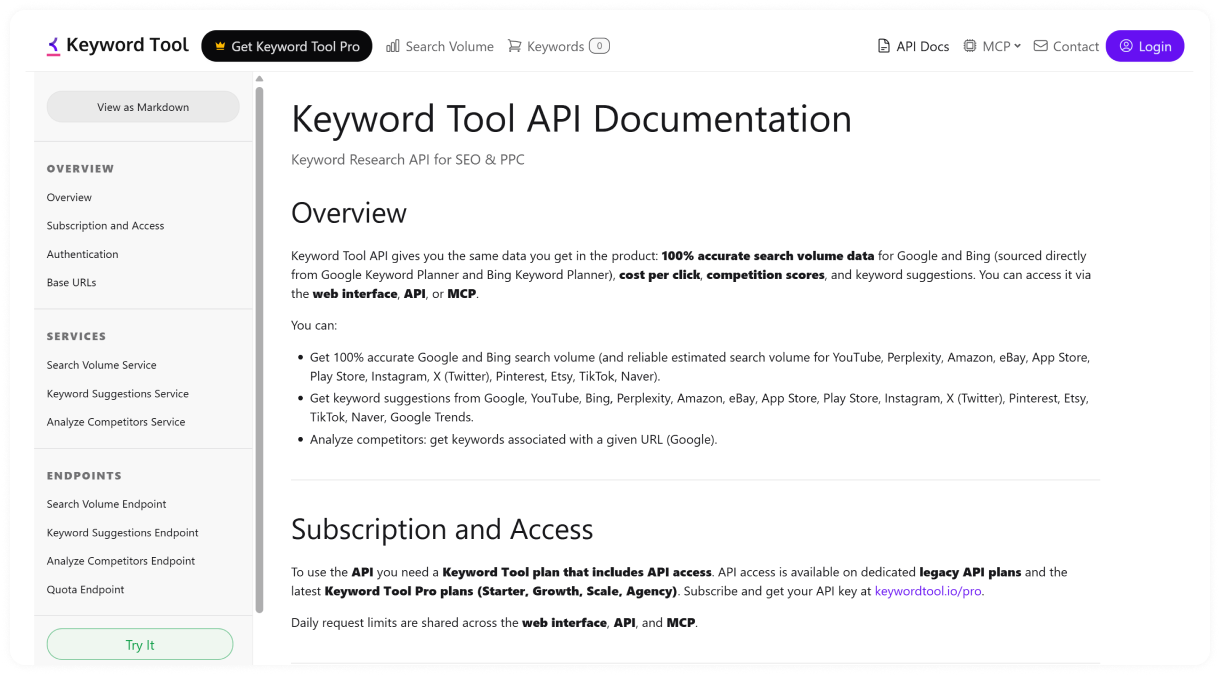
Keywordtool.io is the indie SEO's choice. Their keyword tools API pulls from Google Autocomplete and other sources, generating 10,000+ long-tail variations per keyword. The company stays lean and cheap. Originally built for YouTube keyword research; now covers Google, Bing, Amazon, eBay, and app stores. Best for finding untapped long-tail opportunities.
What Are the Key Features of Keywordtool.io API?
- 200M+ keywords from multiple search engines
- Autocomplete-generated long-tail variations
- Search volume from Google Ads data
- CPC data for commercial intent estimation
- YouTube, Bing, Amazon, eBay, app store data
- Competitor URL analysis
- Content brief generation
- SERP analysis for top 10 results
- Supports 83 countries and 45 languages
- Monthly updates to keyword research API
What Are the Pros and Cons of Keywordtool.io API?
Pros:
- Long-tail discovery is exceptional (autocomplete-based)
- Multi-platform keyword data (YouTube, Amazon, etc.)
- Simple API structure; easy to integrate
- Good for solopreneurs and freelancers
- Monthly subscription, no long-term commitments
- Excellent for e-commerce keyword research
Cons:
- Only 200M keywords total (SE Ranking has 500M)
- No SERP feature data in the API response
- Keyword difficulty score is basic
- Monthly data updates lag competitors
- No intent classification
- Rate limits are low (100 req/min)
- Keyword volume estimates are Google Ads-based (inflated for some niches)
- No backlink or competitive data
What Is the Pricing of Keywordtool.io API?
- The Starter plan runs $88 per month. It allows exactly 50 requests per day.
- The Growth plan costs $188 per month. It allows exactly 100 requests per day.
- The Scale tier is $388 per month. It provides exactly 200 daily requests.
- The top Agency tier demands $788 per month. It provides exactly 400 daily requests.
- Daily request limits are shared globally across the standard web interface, the MCP server, and programmatic calls.
Best Use Cases of Keywordtool.io API?
- Freelance SEO consultants with 5-15 clients
- E-commerce platforms optimizing product pages
- YouTube SEO and video keyword research
- Long-tail keyword discovery for content strategies
- Bloggers and indie content creators
- SaaS companies with bootstrap budgets
- Local SEO agencies managing 1-20 locations
How to Choose the Right Keyword Research API for Your Needs?
Your decision comes down to 3 factors:
- Data accuracy. SE Ranking's weekly updates beat monthly updates. If you're doing SEO for finance, e-commerce, or health verticals where precision matters, SE Ranking wins. SpyFu's data is 10-15% less accurate, but fine for competitive analysis.
- API rate limits. Running 10,000 keyword queries per day? You need Semrush (1,200 req/min) or SE Ranking (600 req/min). Running 500 queries? Keywordtool.io's 100 req/min works fine.
- Feature integration. Need link data? Use Ahrefs. Need PPC data? Use Semrush. Need competitor intelligence? Use SpyFu. Need pure keyword volume and difficulty? Use SE Ranking.
I've personally integrated four of these into client platforms. SE Ranking and Ahrefs are production-ready. Semrush requires enterprise support to set up properly. SpyFu and Keywordtool.io are solid for mid-market use cases.
Conclusion
After running this comparison, SE Ranking emerges as the best keyword research API for most SEO professionals. The combination of accuracy, affordability, and API structure beats alternatives. Weekly keyword data API updates keep you ahead of competitors. 600 req/min handles most workflows. The SEO keyword API integrates cleanly into your existing tools.
That said, choose based on your actual constraints. If you're a solo blogger, Keywordtool.io does the job. If you're an agency managing 100+ clients, Semrush's keyword suggestion API and enterprise support justify the cost. If link data matters to your work, Ahrefs is the only choice.
The keyword research tool API market is mature. All five tools work. None are scams. The question isn't which is best — it's which aligns with your budget, your clients' needs, and your technical stack. Test all of them during free trials. Pick the one that doesn't feel like friction in your workflow.
FAQ: Common Questions About Keyword Research APIs
1. Can I switch between keyword research APIs without losing data?
Yes. Export your keywords as CSV from any tool, then upload to another. Your difficulty scores and search volumes will differ slightly between platforms (10-20% variance is normal), but your target keywords remain the same. I've migrated clients from Semrush to SE Ranking without friction. Just don't expect perfect continuity on metrics.
2. Which keyword research API is best for international SEO?
SE Ranking and Semrush both cover 140+ countries with localized search volume data. SE Ranking updates faster. If you're targeting Germany, UK, or India specifically, both work equally well. Keywordtool.io covers 83 countries but with less depth in emerging markets.
3. What's the difference between search volume from these APIs?
All keyword research APIs estimate search volume from Google Ads data, clickstream data, or aggregated metrics. No one has perfect data. SE Ranking's estimates are typically 5-10% below Semrush's. SpyFu's are sometimes 20%+ off in low-volume keywords. For high-volume keywords (10K+/month), all four agree within 10%.
4. Can I use these APIs to build my own SEO tool?
Yes, but check the terms. Ahrefs and Semrush allow white-label platforms if you're on the enterprise plan. Se Ranking, SpyFu, and Keywordtool.io have fewer restrictions. Expect 2-3 week onboarding with enterprise providers.
5. Are keyword research API updates real-time?
No. The freshest is Semrush (daily). SE Ranking, Ahrefs, SpyFu, and Keywordtool.io update monthly. Real-time data doesn't exist for SEO because Google doesn't publish real-time search volume data. Anyone claiming "real-time" is lying.
Related reading