Whether you’re planning to add your website to Collaborator or looking for sites to buy placements on, you probably want to know what actually happens before a website appears in our catalog.
Traffic, DR, rankings, and indexation all matter. But no single metric tells you whether a website is worth adding or buying a placement on.
So today, we’ll take you inside our moderation process. You’ll see how websites are evaluated, how ownership and data are verified, what gets a site rejected, and why approval doesn’t last forever.
Key Takeaways
- The main criteria moderators review are traffic, authority, niche fit, Google rankings, audience engagement, design, and overall content quality.
- Site data is pulled from Ahrefs, Moz, Majestic, Serpstat, Google Analytics, and Google Search Console.
- The site-ranking system is not for sale. There are no paid placement slots.
- Approval isn’t permanent: the catalog is regularly cleaned of sites that drop in quality.
- Collaborator’s historical average indexation rate is 96.8%.
What’s the Traffic Minimum to Get Listed?
Traffic is one of the main things moderators consider, but no single number automatically determines whether a website gets approved.
A traffic figure can help describe a website’s reach, but it needs to make sense alongside the rest of the website’s performance.
The important point: Collaborator does not use a fixed traffic threshold as an automatic approval or rejection rule.
What Else Gets Checked Besides Traffic?
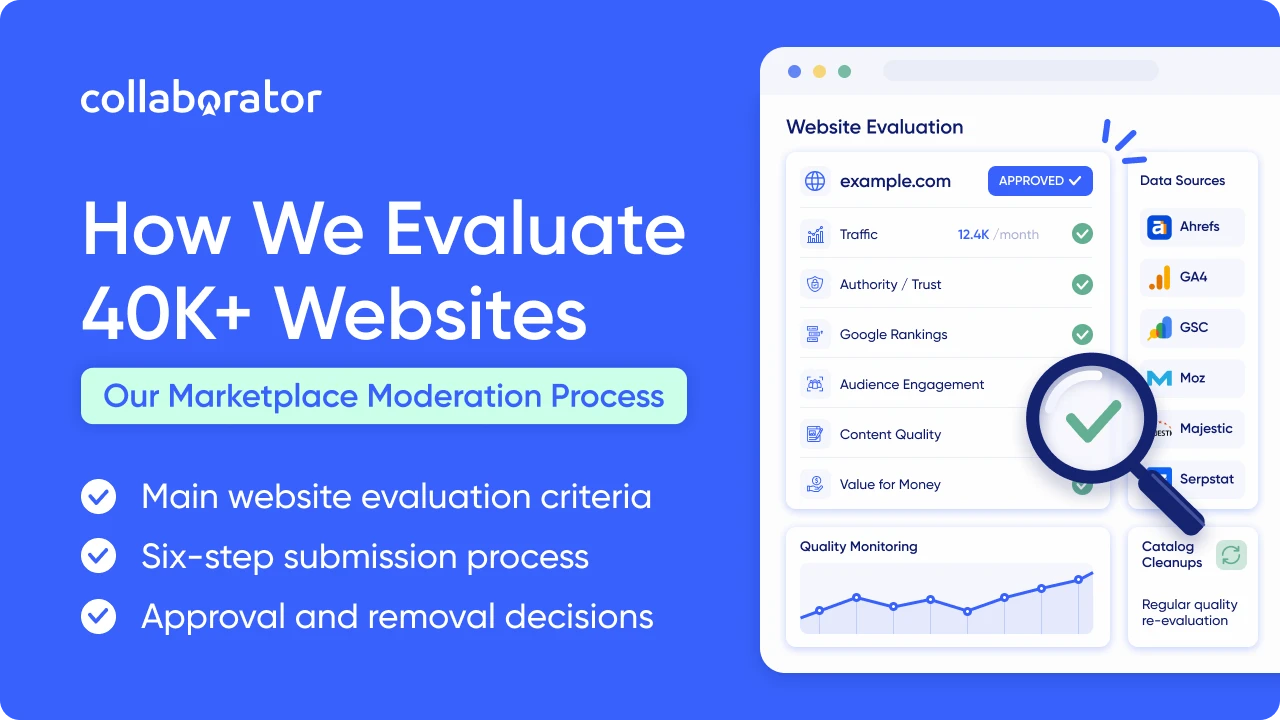
Here are some of the main criteria our catalog team looks at:
|
Criteria |
What It Checks |
| Authority and trust | Is this a real, established website or a low-quality property built mainly to sell links? |
| Niche relevance | Do the content and audience match the categories advertisers are looking for? |
| Google rankings | Does the website rank in Google’s top 100 for real keywords? |
| Audience engagement | Is there evidence of a real, active audience? |
| Design and content layout | Would you feel comfortable having your brand and link appear on this website? |
| Value for money | Does the placement offer enough value for its price? |
No single criterion overrides the others. A website with a strong DR and no real engagement can be flagged just as easily as a high-traffic website with no topical relevance.
How Is the Site Data Verified?
Metrics come from Ahrefs, Moz, Majestic, Serpstat, Google Analytics, and Google Search Console. Relying on just one source would mean trusting that source’s blind spots too.
Website ownership is verified using one of several methods:
- Google Analytics 4 — the priority method
- Google Search Console
- HTML file upload
- A confirmation message from the website’s listed contact email or an email address on its domain
- In rare cases, verification by contract or manual review when none of the standard methods is available
GA and GSC data matter more than they might initially seem. A DR score is useful, but it is still a third-party estimate and only tells you part of the story.
When GA or GSC data is attached, you’re looking at first-party traffic and search-performance data recorded for that website, not only a third-party estimate. Here’s what that looks like in the Collaborator catalog:
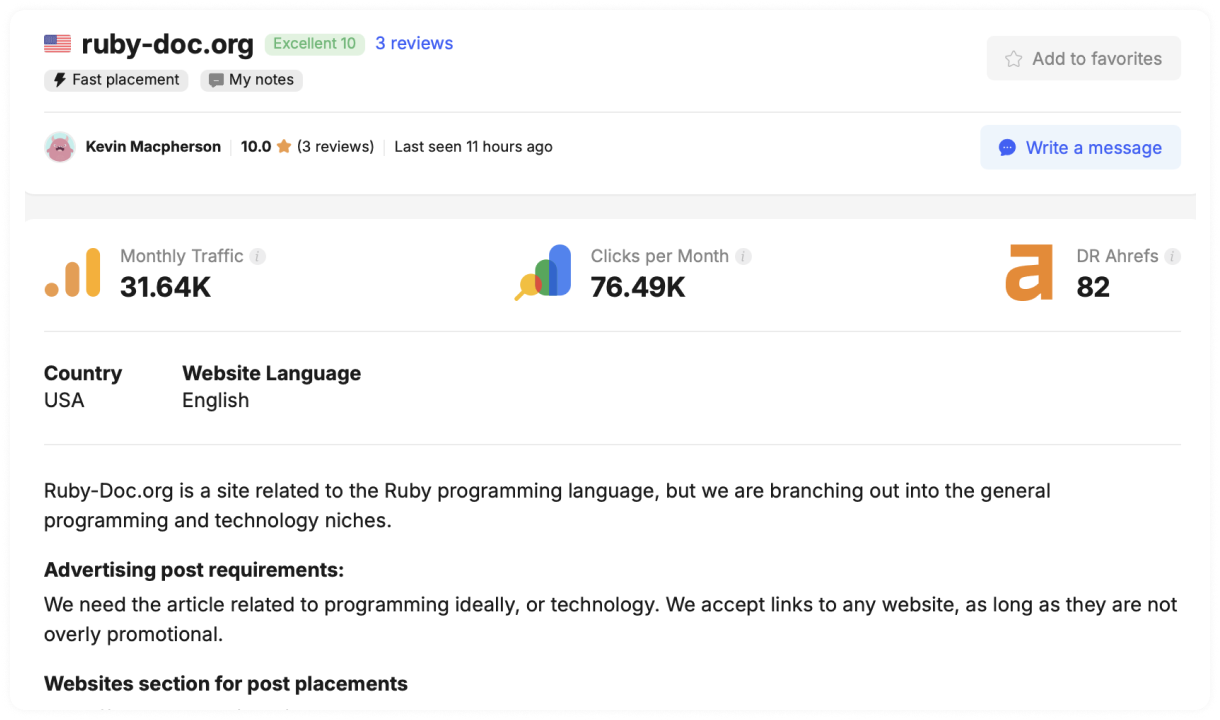
Moreover, our analysis of 7,500+ websites found that Ahrefs, GA, and GSC can report very different numbers for the same website. That’s why it’s always better to compare multiple sources instead of relying on one metric.
How to Add a Website to Collaborator
Adding a website to the catalog is a six-step process, and most of it only takes a few minutes:
- Sign up for a free Collaborator account.
- Click “Add Site” in your dashboard.
- Enter your website’s address.
- Verify ownership through Google Analytics 4, Google Search Console, an HTML file upload, or one of the alternative methods above.
- Fill in your website’s data and pricing.
- Wait for moderation. Reviews normally take up to two business days, although they may take longer during busy periods. We’ll email you once your website has been reviewed.
The moderation step is where the traffic signals, review criteria, and verification methods you’ve just read about come together. But it isn’t an automatic checklist.
Moderators also look for signs that traffic or other metrics have been artificially inflated and assess every website in context.
That means the team may reject a website that appears to meet the requirements on paper. It can also make an exception when a website offers genuine value despite not meeting every criterion exactly.
Once your website is approved, ranking higher in the catalog is mostly in your hands:
- Accumulate more reviews
- Complete tasks as promptly as possible
- Set competitive prices for placements
- Improve your website’s authority and traffic
Why Isn’t the Ranking for Sale?
Collaborator doesn’t sell ranking positions or paid placement slots. It also isn’t a service company that selects and resells placements on an advertiser’s behalf. Collaborator is a marketplace.
The ranking algorithm considers:
- Indexation and availability of published articles
- Speed of task execution
- The ratio of traffic to price within a category
- Reviews
- Technical indicators of the website
- Additional internal quality and performance signals
This is how Collaborator keeps the websites in the catalog worth trusting for as long as they remain listed.
Does Approval Last Forever?
No, and that’s intentional. The catalog is regularly cleaned of websites that have lost traffic, stopped getting indexed, or otherwise stopped meeting the standards that originally got them approved.
This is also the honest answer to the question, “Why don’t you have 100,000 websites?” We don’t need the number. We need the websites in the catalog to still be worth buying a placement on, whether they were approved yesterday or several years ago.
At the same time, approval isn’t temporary by default. Many websites continue to meet our standards, and some have worked with Collaborator since the company was founded more than nine years ago.
What Gets Rejected?
Collaborator may reject:
- Websites that violate laws or copyrights
- Websites that don’t meet generally accepted content or quality standards
- Websites that don’t provide enough market value to justify inclusion
Collaborator’s team also reserves the right to reject a website without providing a detailed public explanation if it doesn’t add real market value. In edge cases, moderation comes down to professional judgment rather than a checklist.
“Our catalog team checks every website for quality, up-to-date metrics, and compliance with our platform requirements. Over the past year alone, we turned down 65,222 websites.”
What Happens if Something Goes Wrong After You Buy a Placement?
Evaluation reduces risk, but it cannot remove it entirely. That’s why Collaborator adds guarantees on top of its website evaluation process:
|
Situation |
What Happens |
| Article or link deleted within three months | Collaborator first works with the publisher to restore it or arrange a comparable placement. If that cannot be done, the advertiser receives a refund to their Collaborator balance. |
| Publication isn’t indexed | The publisher may be required to fix the issue and republish within 15 days, or Collaborator can request a refund on the advertiser’s behalf. |
| Extended paid guarantee | Covers defined events, including deletion and non-indexation, subject to the applicable guarantee terms. |
Guarantee language varies across marketplaces. Before comparing policies, check the actual remedy: a refund, restoration, replacement placement, and platform credit are not the same thing.
Does the Evaluation Process Work?
The most honest way to answer that question is with outcomes:
- 96.8% historical average indexation rate
- 80% of placements go live within 24 hours and 94% within 72 hours
- 9.8/10 average rating across 85,000 placement reviews, based on 238,000 total deal reviews
Those numbers exist because a website that gets waved through without real vetting eventually affects placement results. Loose evaluation and a 96.8% indexation rate don’t coexist.
Related reading
- • Which Website Authority Metric Can You Trust: DR, DA, TF, CF, AS, or SDR. A Unique Study of 40,000 Websites
- • Traffic Analysis of 7,500+ Websites: Ahrefs vs Google Analytics vs Google Search Console. Unexpected Results
- • Accuracy of Ahrefs, Semrush, and Similarweb: Which SEO Tool Is Best for Traffic Analysis?
- • How to Monetize Website Traffic? Top Strategies for Making Money on a Website in 2025