In this article you’ll learn about 7 key SEO content trends that define success in search promotion, and get ready-to-use strategies for applying them. Anastasiia Kryzhanovska explains what to do to receive not only traffic from Google and AI answers, but also earn the readers’ loyalty.

Read the detailed summary of Anastasiia’s talk on the transformation of search marketing and the rules for adapting to the new realities — with practical insights and step-by-step instructions.
How AI Changes SEO Reality
We need to learn to live in a world where Google provides information directly, and clicking through to websites is only optional.
Before moving on to specific trends, it’s important to talk through and recognize the global shifts already happening in SEO and content in general. Understanding these changes is the key to correctly interpreting new tendencies and using them to your advantage.
The mass scale of AI content
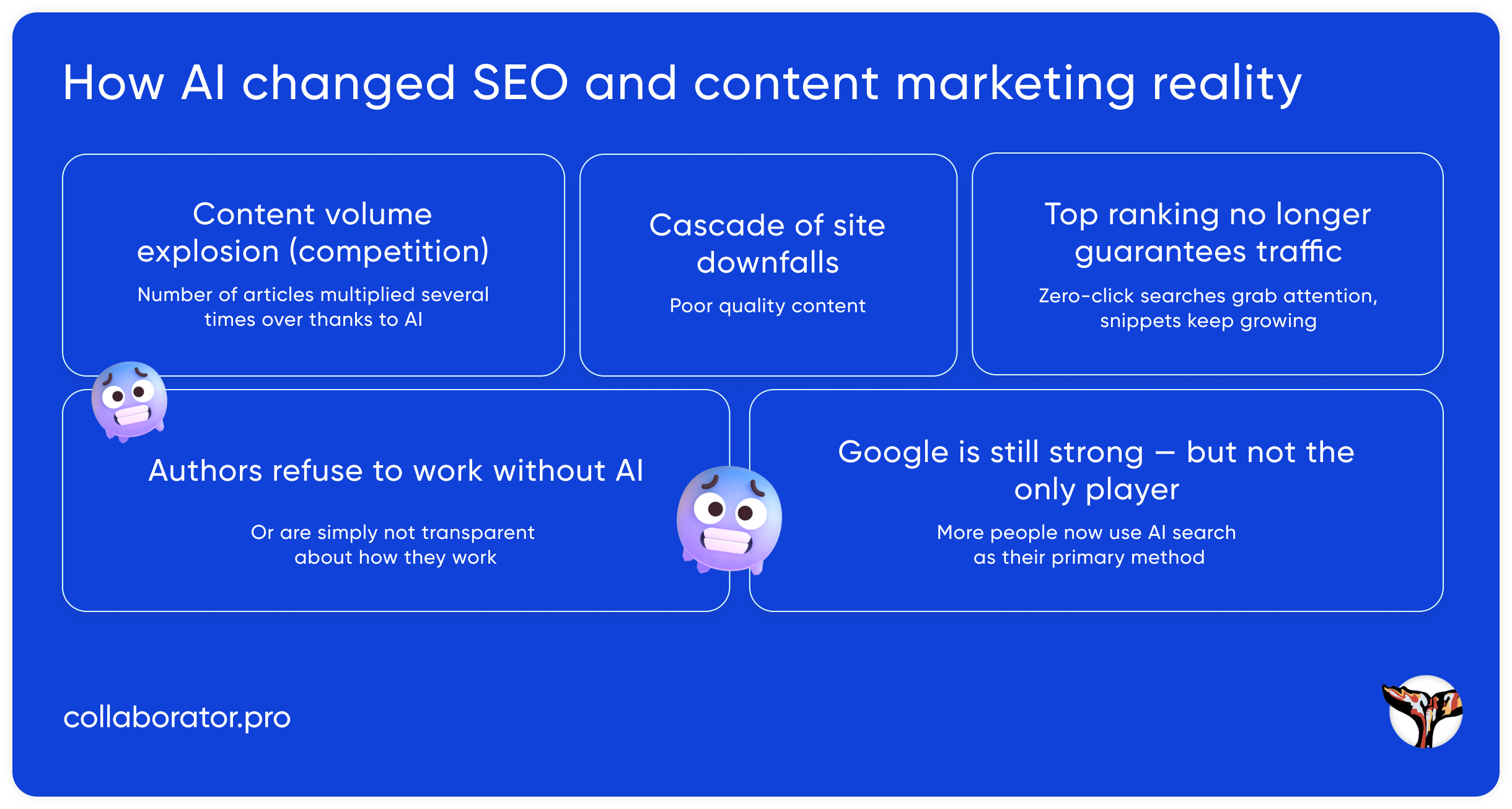
There are even more articles, the competition is insane, and new content struggles to stand out. With the appearance of AI, in just the past few years text creation has become extremely fast.
Many began to actively experiment with AI, often without any concern for the quality of generated materials. As a result – a series of site downfalls, and eventually SEO specialists and content clients starting to flatly refuse AI-generated texts.
At the same time, almost all content is now created with AI participation — directly or indirectly. ChatGPT, Claude, Gemini, Copilot and other tools have already become part of the routine work of many writers, even if they don’t admit it.
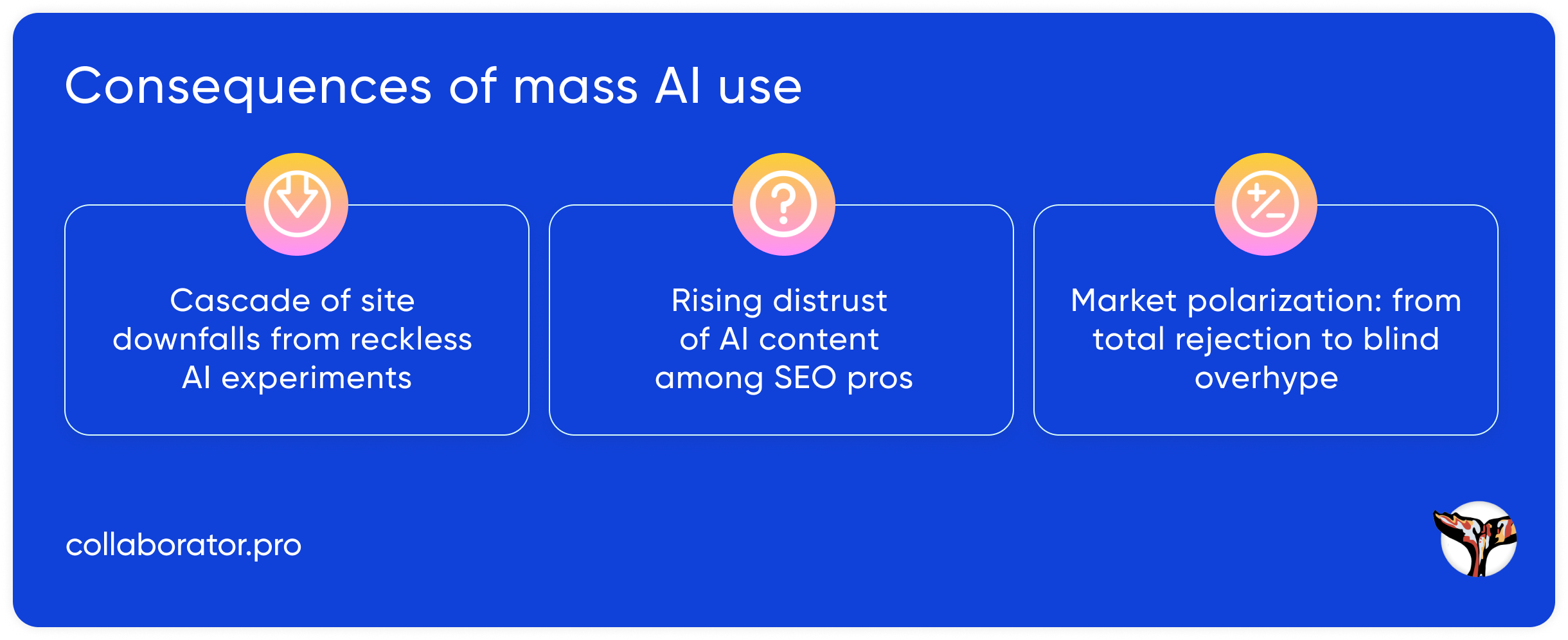
The main challenge now is not AI itself, but the fact that not all authors know how to use it wisely and effectively in favor of content quality.
Revolution in User Search Behavior
Another aspect of change concerns the transformation of search itself. Google is still the mastodon, the leading source of information. But more and more people are turning to AI first with their queries.
The new search model looks like this:
- AI chats for quick queries and initial information.
- Traditional search engines for deep research and verification.
Explore the best ChatGPT use-cases for SEO in our full guide👈
Transformation of Google SERP
Google no longer guarantees traffic as such, and people often don’t even click through to sites.
Top positions in Google no longer guarantee stable traffic. Why?
- Search results are filled with various snippets and interactive blocks.
- The share of content from social networks (Reddit, YouTube) is increasing.
- The first organic results are noticeably pushed down and appear only after scrolling.
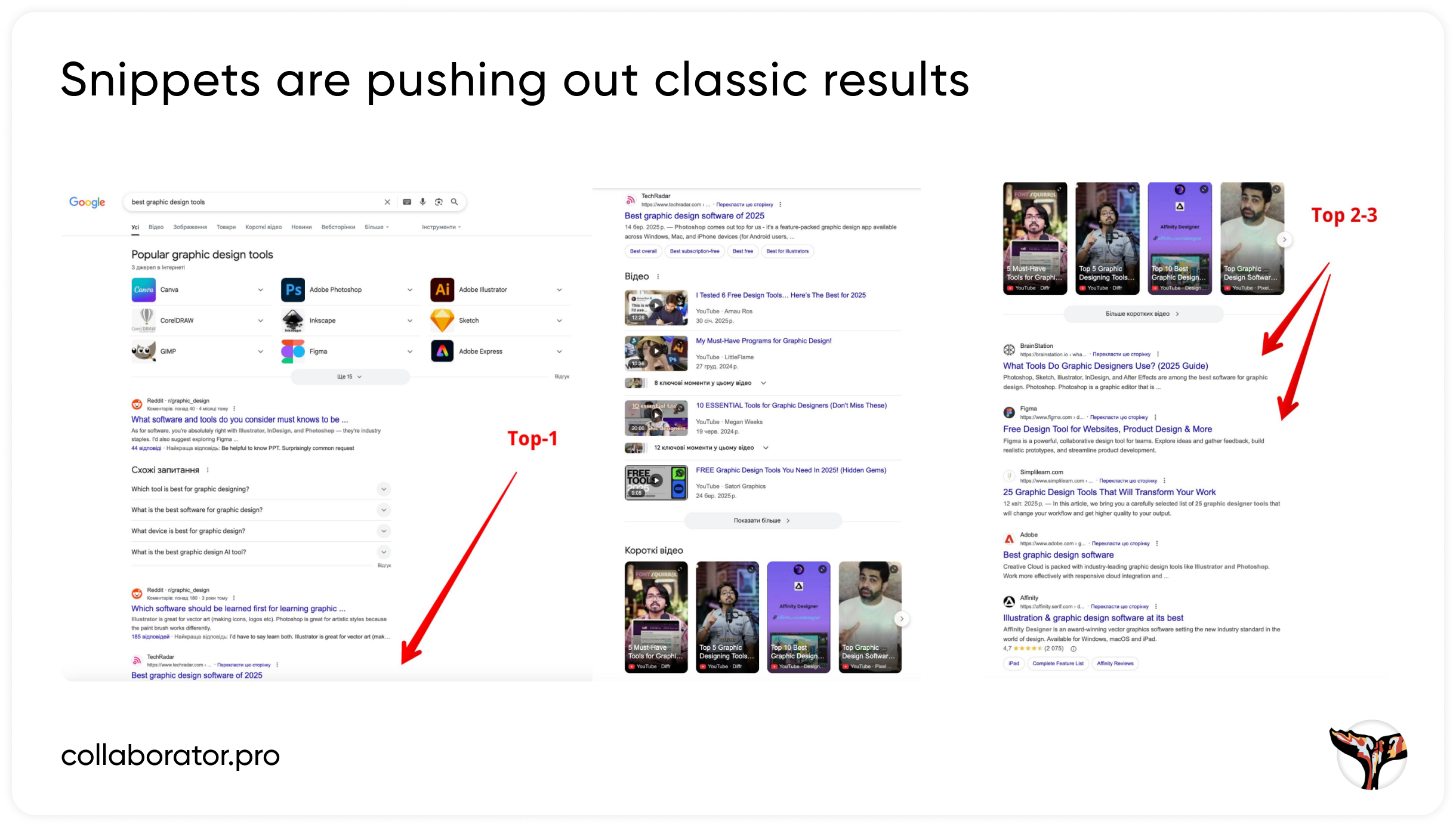
The first organic result for a popular commercial query shows up at the bottom of the first screen, and positions 2–3 may not be noticed by users at all.
While this is not yet happening for all keywords, the trend is obvious: algorithms are changing, Google is actively integrating content from third-party platforms and expanding its own blocks in the search results.
7 Main SEO Content Trends in 2025
The changes above have shaped a new reality of search traffic. It’s defined by the following:
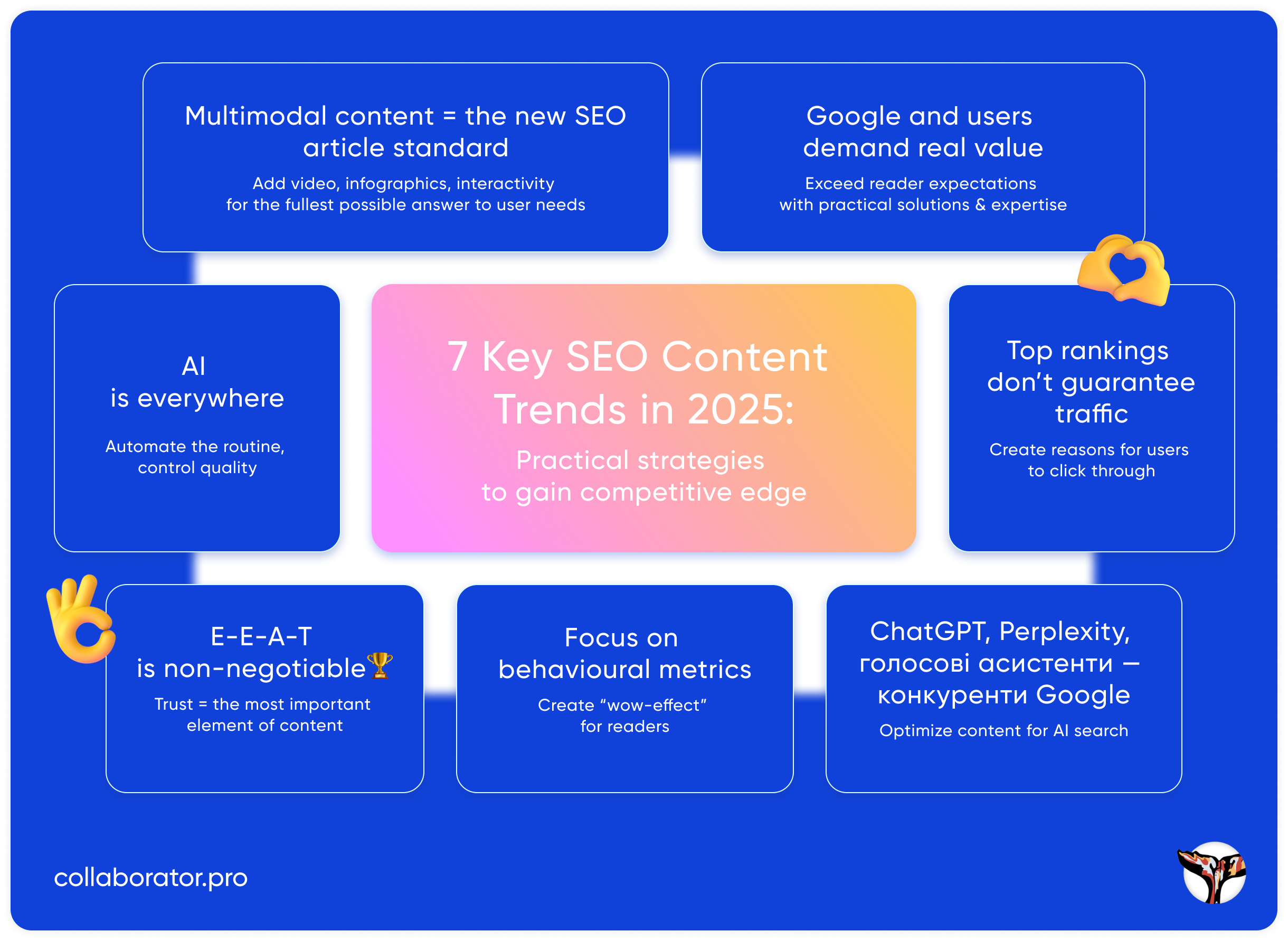
Next we’ll look at practical strategies that allow not just to adapt to the new reality, but to use current trends for gaining competitive advantage in search promotion.
AI Everywhere
The first and most obvious trend is the mass use of artificial intelligence. Already now, most content is created with its help in one way or another. It’s not so much about fully generated texts, but about using AI tools as assistants in research, structuring, planning, text checking, etc.
Ignoring this reality means deliberately losing to competitors who have already adapted to the new opportunities. AI develops extremely fast. What it could do a few months ago and what it can do today are two different stories:
- text quality is constantly improving.
- new tools for visual content creation appear.
- the range of tasks AI can solve keeps expanding.
This means one thing: you must constantly keep your finger on the pulse and adapt to changes.
In practice, many companies fall into extremes: either they create a mass of low-quality, meaningless content due to excessive automation, or on the contrary, completely reject AI and lose to competitors.
💡 Correct strategy for AI use in SEO content:
- Automate small tasks. Let AI write headlines, meta descriptions, tweets, notifications, technical email newsletters, etc.
- Delegate routine support processes. AI handles tasks that don’t require human involvement, personal experience, or critical thinking, like briefing, structuring, grammar or style checks. Not using these tools means paying extra for what can be simplified.
- Optimize components of big content. Even in complex articles, AI can be used to create separate elements — lists, quotes, individual phrases.
- Control and a healthy approach. The key factor is a human at the head of the process. An experienced professional should manage AI, making it an assistant for automation and speeding up workflows.
For now, AI still cannot independently create truly high-quality, in-depth, and useful SEO text.
Check out our podcast with Tom Winter on how to apply AI in everyday SEO workflows👈
Quality and Usefulness of Content in Focus
People demand unique value, not repetition of known and basic information.
The quality of SEO texts is a strategic vector for the development of search promotion as a whole. And what’s interesting: the more articles are created with AI, the higher the requirements for their quality — from both search engines and readers.
Google, with every update, clearly declares the importance of creating materials primarily not for robots, but for people. The search engine is getting better at distinguishing quality content from shallow or template-driven. This is no longer just an algorithm, but a powerful machine that filters, evaluates, and shapes results based on usefulness and reliability.
At the same time, people are also tired of AI generated content and have learned to recognize it. That’s why, when among monotonous, low-informative articles one appears that gives real value, practical help, experience, expertise, or a new perspective, it immediately stands out and attracts attention.
Earlier, to satisfy user intent it was enough to share basic lists with short descriptions. Now readers expect detailed comparisons, real experience examples, lists of pros and cons, in-depth explanations and conclusions.
Both people and Google demand more quality content.
💡 What this means:
- Real value for users. Content should not just answer the query, but exceed the reader’s expectations.
- Exact match with search intent. Aim to satisfy the query as precisely as possible.
- Depth and completeness of coverage. The content should fully reveal the topic within the relevance of the query.
- No unnecessary filler. The material should match the level of the target audience.
- Unique author contribution. Even in generic topics, add value and usefulness through the author’s own experience or expert opinion.
- Clarity and logical structure. Information should be presented consistently and skillfully guide the reader's attention.
- Practical usefulness. Every element of the content should have a practical application for solving the reader’s problem.
- Accuracy and truthfulness of facts. Use verified facts, current data, and references to authoritative sources.
Google clearly declares this, and AI tools also rely on the same principles when searching for information. Both Google and people want the same thing — useful, in-depth and clear content. Typical templated texts are losing their value. If AI can write them, why pay for them? If they don’t rank, why create them at all?
If you can automate work without sacrificing quality, do it. But quality must come first. And in 2025, it becomes the main competitive advantage.
Even More Weight on Behavioral Metrics
Before, “technical” optimization of articles worked pretty well. But more and more, what matters is real experience, the ability to write in a way that’s interesting, and to stand out in a sea of sameness.
Google is focusing more and more on user behavior, emphasizing how they interact with content. Behavioral signals tell whether the material is high-quality and matches user expectations.
This isn’t a new vector for the search engine: the importance of user interaction has been mentioned since the Google Search Quality Rater Guidelines. But the latest Google Update in March 2025 doubled down on it.
User behavior is an abstract concept that Google measures with concrete parameters:
- CTR (clickability of headlines);
- bounce rate;
- time on page;
- scroll depth;
- clicks to other pages;
- interaction with interactive elements.
The era where you could rely solely on technical optimization is fading. What’s rising in importance is the author’s real experience and their ability to write engagingly.
💡 How to put this into practice:
- A strong and unique headline. The reader must instantly get why this article is worth reading instead of one of the thousand similar ones.
- A hooky intro. It should grab attention, promise something useful, and be hyper-relevant to the reader.
- Focus on user intent and depth. The content not only answers the query, but does it as fully as the reader needs.
- Internal linking. It’s not enough to just pick thematically similar articles. Think: what would be interesting to the person reading this exact paragraph? When the reader clicks a link and checks out a related piece, Google gets a strong signal of relevance and quality, meaning more trust in your content.
- Maximum of personal experience and practicality. You can’t just rewrite what others have already said. Don’t expect that an article with the same content as those already at the top will rank better thanks to technical optimization or backlinks. This is a harder game — the one who wins is the one delivering truly unique value.
The current reality forces us to think bigger. When it’s harder to get traffic from search, when even top positions don’t guarantee a steady flow of visitors, and competition for quality content is insane, what becomes critical is how many people come back to your site on their own, not just through SEO search.
Writing just for keywords is outdated. It’s not enough to answer the query — you need to create a “wow effect.” The reader has to get more than they expected: practical usefulness, emotional satisfaction, the feeling they landed on a truly valuable resource.
It’s important to show the company’s values, provide extra goodies on the site that don’t just solve an immediate need, but also make the reader want to bookmark the resource. You need to care not only about practical usefulness, but also about emotional connection.
Create content with different types of value:
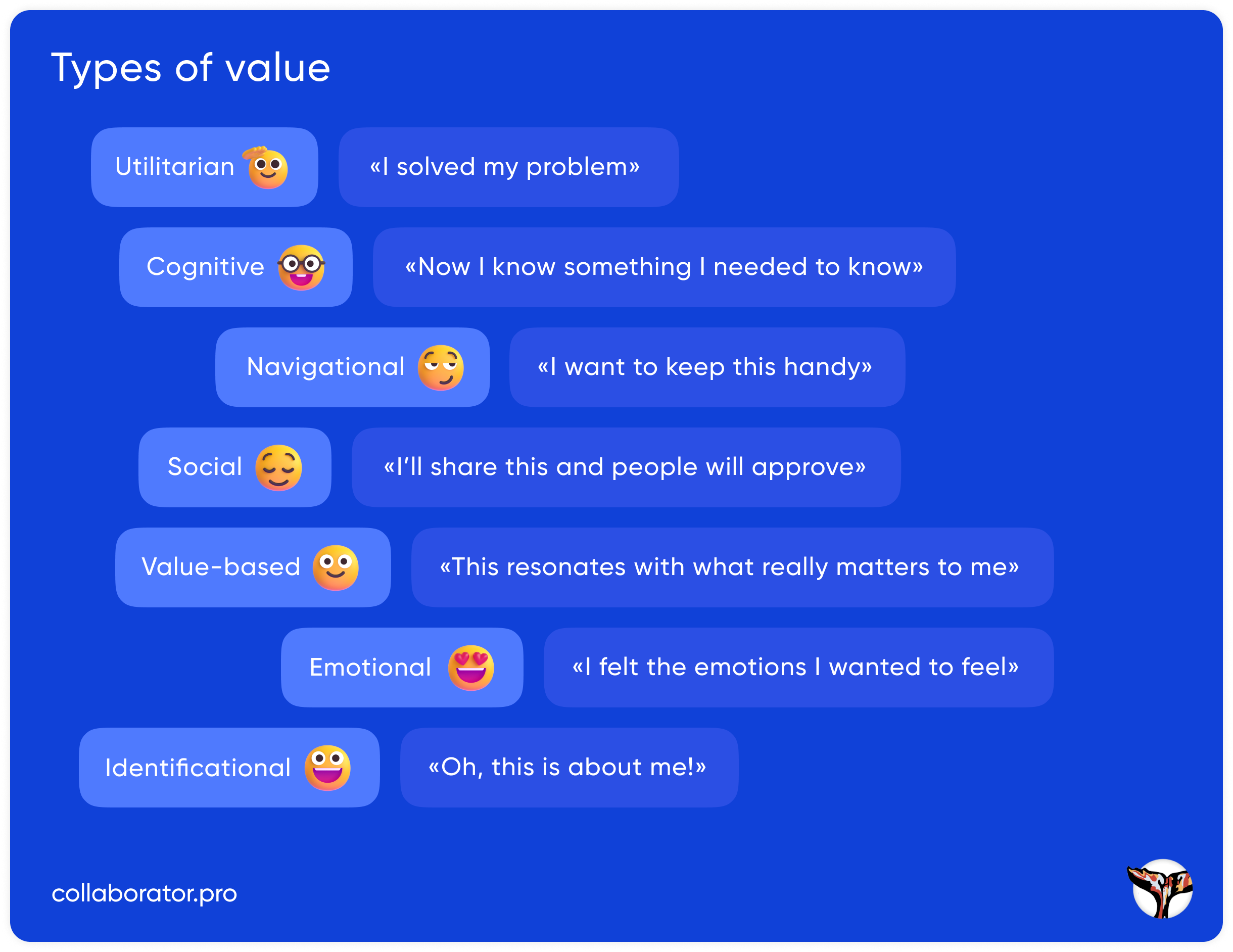
At the same time, think about brand presence across other channels: Reddit, social media, YouTube — anywhere you can be seen and remembered. This builds recognition and trust, which later converts into repeat visits.
Basically, we’re talking about SEO content that plays a much bigger role than before: not just attracting through a query, but winning people over, meeting and exceeding expectations.
Even More Weight on E-E-A-T
Experience, Expertise, Authoritativeness, and Trustworthiness — this term has been around for years, but 2025 makes it not just a recommendation, but a mandatory condition for success. Google has greatly improved its ability to tell whether content actually comes from an authoritative, trustworthy source.
Two key aspects of modern E-E-A-T:
- Personal experience of the author. It’s not just about having an author’s name under the article, it’s about real expertise. Google is learning to separate content written by someone with actual firsthand knowledge from content that is just a summary of other sources.
- Trustworthiness — the most important element of E-E-A-T, according to Google itself. Trust comes from factual accuracy, transparent sources, and honesty in how info is presented. That means no exaggerations, manipulations, or false promises.
💡 How to put this into practice:
- Show authorship and bios on the site.
- Ensure the author has a real, relevant presence on social media, does interviews on niche platforms, speaks at events to build a personal brand.
- Cite reliable sources.
- Add transparent, precise facts: specific studies, confirmed data.
- Avoid emotional manipulation: what wins now is solid argumentation, objective evaluation, and honesty in delivery.
- Regularly update content.
- Provide detailed company info on the site: clear description, including legal address, privacy policy, and easy ways to contact.
- Don’t put up aggressive ads on the website: flashy banners and clickbait headlines kill trust — both from users and search algorithms.
Google’s Top No Longer Guarantees Traffic
Search results have changed radically: organic results now compete with snippets, AI Overviews, and answer blocks that often fully satisfy the user’s need for information.
Some data says up to 65% of searches end right on the Google results page. People get what they want from snippets and answer boxes without clicking through. At best, they might expand a snippet — but not go to the site.
Google has transformed from a catalog of pages and articles into a self-sufficient information platform. Instead of sending users to websites, the search engine more often tries to give a full answer directly in the results. This is the new reality. We need to adapt our strategies, not fight it.
💡 How to put this into practice:
- Headlines for CTR. A strong headline must have a clear, obvious reason for someone to click your article: phrases like “full list,” “practical recommendations,” highlighting usefulness, expertise, uniqueness, but without clickbait.
- Useful interactivity. Not just info, but interactive elements: calculator, comparison, test — something that requires visiting the site.
- Try to get into snippets. The earlier points help bring people to the site. At the same time, understand that modern SEO means being present in all result formats: on your site, in AI Overview, FAQ blocks, Featured Snippets. That also means working with platforms Google actively indexes — Reddit, YouTube, etc.
- Convert visitors into your own client base once they land. If it’s just an informational article, at least convert them into your email list, Telegram channel, etc.
👉 To keep up with the trends, explore the best SEO blogs to follow in 2025
Google Has Strong New Competitors
The total number of search queries on Google is still growing, but more and more people now go to AI to answer their questions first.
User behavior has shifted drastically: people choose the shorter path and start with AI tools — ChatGPT, Perplexity, voice AI assistants. Only afterward do they move on to Google search.
Stats still show Google searches going up. But this growth looks like it’s right about to hit a plateau. It’s totally possible that in the next few years we’ll see Google’s share of search shrink significantly.
These changes are worth preparing for now, while the momentum is still on Google's side. According to unofficial estimates, up to 30% of searches already happen through AI tools. Even if that number’s exaggerated right now, the trend is obvious and it’s just a matter of time.
💡 How to put this into practice:
- Focus on AI search: accept the new reality and adapt your strategies.
- Optimize content for snippets and AI: aim to be among the sources AI pulls from. When ChatGPT provides answers with links, clicks from there also count as search traffic.
- Create content AI can’t replace: unique, expert, useful, interactive.
- Track impact metrics: articles are now sales-funnel elements, not just traffic drivers. Every piece should convert into subscriptions, sales, or other meaningful actions.
- Go for traffic strategically beyond Google: content distribution and social presence are no longer optional, they’re strategic must-haves. People search for info on YouTube, Reddit, TikTok, and other platforms too. Bring your content to where people are already looking.
Article Structure
Good structure used to be about making content easier to read. Now it’s a technical must-have for ranking. A proper structure + authority is what lets you hit top spots in Google, AI Overviews, snippets, and AI tool sources. On top of that, readers themselves understand structured, block-style text better.
Key elements of structure:
- clear logic;
- navigation;
- subheadings;
- direct, quick, specific answers;
- short paragraphs;
- lists;
- tables;
- contextual hints;
- different content formats inside;
- FAQ.
Google now gives more weight to structure, consistency, and markup. AI Overviews pull info more easily from well-organized material. AI tools also rely on technical markup: logical flow of info, navigation, headings.
Contextual hints are especially key: they tell AI exactly where the answer to a given question sits. For example: “Here’s a list of problems relevant in this niche” signals that what follows is useful for a user’s query.
Well-structured content = higher chance of showing up in Google results and AI Overviews. It’s also more digestible for users trained on short-form, feed-style info — similar to scrolling social media with quick blocks of text, video, images, diagrams, memes, etc.
Multimodal Content as the New Standard
Model the feed-like experience, give people a reason to click through, and feed snippets/AI with multiple formats that fit different queries.
A modern SEO article can’t just be plain text. What used to feel like “extra work” — making interactive pages — is now the new normal.
We need to push people to click through, prepare for AI search, and optimize structure on a technical level. That all demands a mixed-content approach.
Elements of multimodal content:
- text — still the backbone of the article, but heavily supported by:
- visuals: infographics, demo images;
- embedded videos — product demos, interviews, explainers;
- structured data — quotes, comparison tables, lists;
- interactive stuff — calculators, checklists, tests;
- conversion elements — CTA forms, buttons;
- FAQ — quick answers to popular queries.
This doesn’t mean stuffing every element in. The key is analyzing search intent. Think: what’s the best way to answer the user’s exact question? Where does text work, and where does video or a GIF make it clearer? Which interactive element would help most? Every piece should be a direct response to what real people are asking when they land on your page.
Benefits of the multimodal approach:
- Simulates social feed experience: variety keeps attention.
- Incentive to click through: interactivity gives more than an AI snippet.
- Flexibility: different formats fit different query types.
- Technical optimization: covers most modern SEO factors.
The New Reality of Content Marketing
Content marketing in 2025 is about competing on quality and how well you meet the needs of people searching for info. That applies to how you present content, the channels you’re active on, and how well you understand shifts in search behavior.
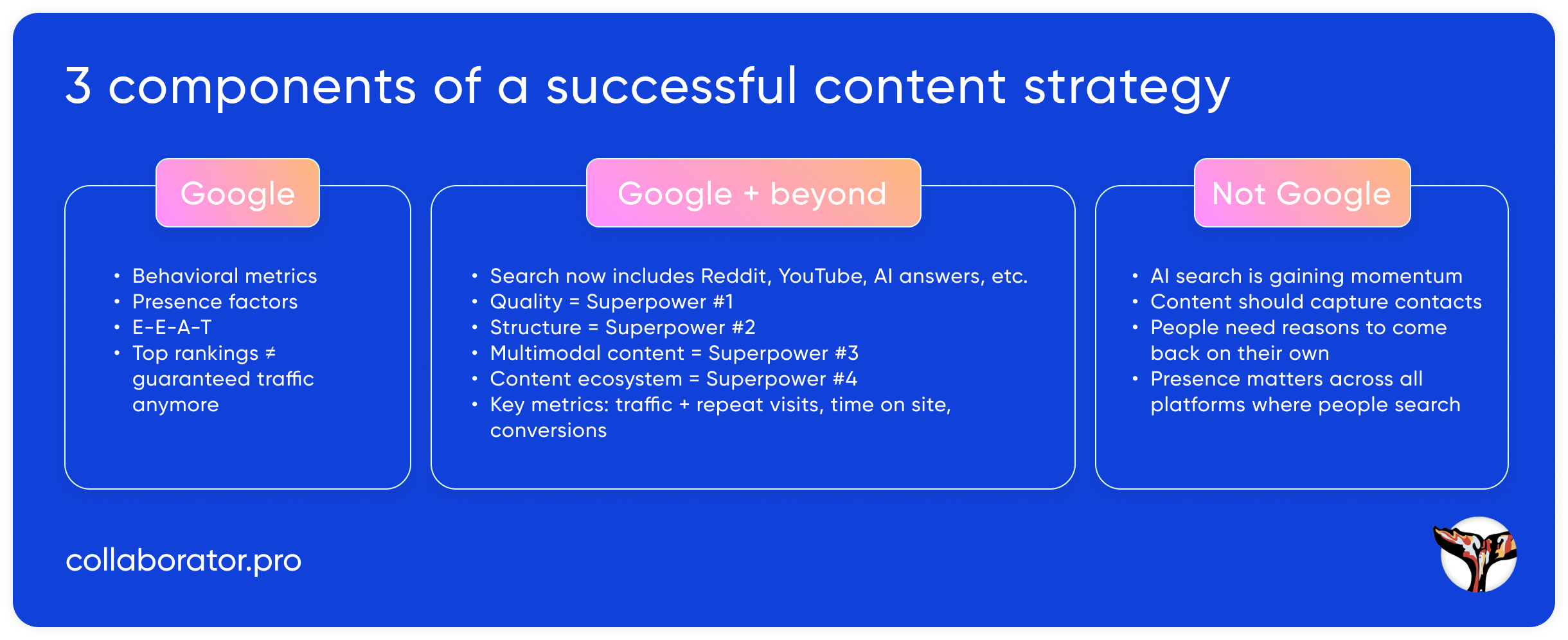
Three components of a successful content strategy:
-
Optimization for Google: behavioral metrics — how people interact with content; presence factors — authors and the company must be visible; E-E-A-T principles — adherence to Google’s guidelines on expertise, authoritativeness, and trustworthiness; recognizing that a top spot in Google no longer guarantees traffic.
-
Presence in social media and AI answers: Reddit, YouTube, Facebook, LinkedIn; AI answers and snippets; leveraging superpowers in the form of quality, structure, multimodal content, and a content ecosystem; analyzing and accounting for key metrics — traffic, repeat visits, time on page, conversions.
-
Systemic approach: adapting content for AI search; articles should drive repeat visits to the site; presence at every search touchpoint.
Create content that people like not just for its usefulness, but because it resonates with their values. The content that works is the one that hits.
FAQ
❓ What are the main rules for re-optimizing service content if your main keywords rank between 9–20?
The first thing to look at isn’t the keywords themselves. Google has gotten really good at working with context. Try to grasp the search intent: what exactly are people looking for with those queries? If your content isn’t ranking as high as you want, it’s probably because, in Google’s view, it doesn’t serve the query well enough.
I’d first analyze what’s in the top results and think: why does Google prefer those pages? Then ask: what can we do better?
❓ Are longreads still popular? What’s the optimal article length now?
Right now, I don’t think there’s such a thing as an “optimal length.” Each query needs its own approach. In the top results, you might see a short and a long article side by side, each serving the same query in different ways. Again, it’s all about matching search intent.
❓ Besides ChatGPT, which language models do you prefer for content creation?
I use two tools: ChatGPT and Claude.
- ChatGPT is more technically advanced, it’s better at handling context across different chats and remembering conversation history. It’s convenient.
- Claude handles language better — the texts come out more natural. Not for long articles, but for emails, for example, Claude’s style is cleaner than ChatGPT’s.
❓ In the English-speaking internet, AI answers have been in search for a year. What approaches have info-site owners already developed?
Don’t fight reality — think about how to get the most out of it. How do you land as a source in AI? How do you make sure that even with an AI answer, your headline still gives people a reason to click your site? You have to play on the field where this reality exists.
Right now, a lot of people are asking how to get into AI recommendations, since more and more traffic is coming from AI answer sources. That’s what needs to be leveraged.
❓ If a site registers officially as a media agency, is that enough to be considered “authoritative”?
It can’t be the only factor. Official registration, license, and listing an address on the site are definitely good and add weight. But that doesn’t mean you can skip building authority through sources, developing your authors’ brands, etc. All these components work together.
❓ Are the sites shown in AI Overview connected to those in organic results? What’s the chance of appearing both in AI Overview and top Google results?
There’s definitely a connection — AI tools rely heavily on what ranks in the top results.
Hard to say what the actual probability is. I doubt there’s solid stats. But if you make it into both an AI tool and, say, top 5 in Google results, you’ll get a lot of traffic.
❓ Is it worth checking content with AI checkers?
AI checkers aren’t perfect. You can write with ChatGPT in ways that trick them into not detecting it’s AI-generated. At the same time, they often give false positives, especially in technical topics — where a human-written text gets flagged as AI.
They can be useful as a guide: if the tool shows a high AI score, it means the text is too templated. But you really shouldn’t obsess over those percentages.
Thanks to Anastasia for the useful insights and practical SEO-content ideas. And to our readers — stay one step ahead, and keep turning knowledge into competitive advantage💪